Readability Score Checker
Paste your text to see its readability score, reading grade, long sentences and hard words.
Recent
Your last 10 settings, saved only in this browser. Nothing is uploaded.
Popular tools
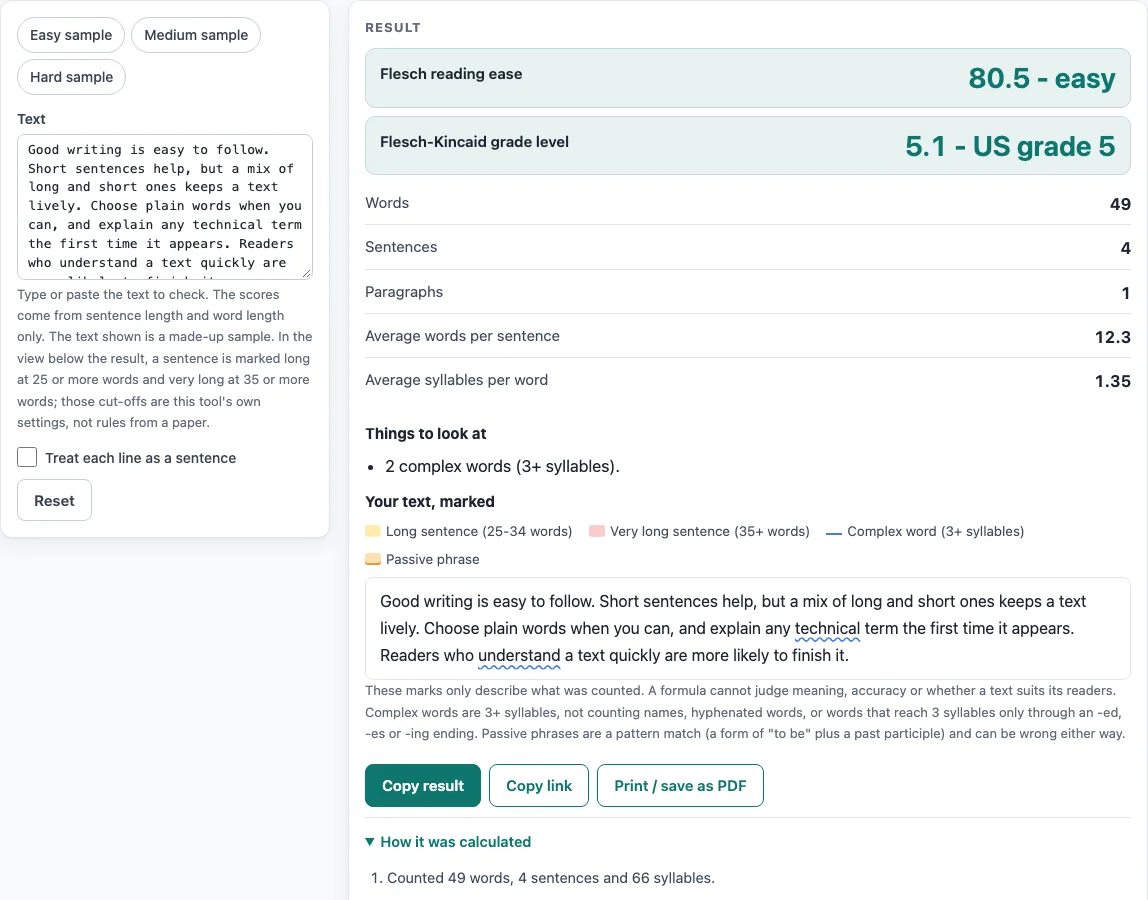
How to use the Readability Checker
- Click the Text box and paste or type your text. The scores update as you type.
- Read the Flesch reading ease number and its band, such as “80.5 - easy”. Higher numbers mean easier text.
- Read the Flesch-Kincaid grade level and its US label, such as “5.1 - US grade 5”. Lower numbers mean easier text.
- Check Words, Sentences, Paragraphs, Average words per sentence and Average syllables per word to see what is pushing the scores.
- Read Things to look at for counts of long sentences, passive phrases and complex words.
- Scroll to Your text, marked to see each sentence coloured by length, complex words underlined and passive phrases highlighted.
- If each line is a separate sentence, such as a list or a poem, turn on Treat each line as a sentence and read the scores again.
To try the tool first, click Easy sample, Medium sample or Hard sample to load example text. The text box analyses up to 200,000 characters, and a warning appears if your text is longer. If the box is empty, the page asks you to type or paste some text first. Use Copy result, Copy link or Print / save as PDF to keep the result, and Reset to return to the sample.
If you check text on other web pages a lot, the Readability Desk Chrome extension scores the text you select without copying it here.
What is a readability score?
A readability score is a number calculated from sentence length and word length. This page shows two: the Flesch reading ease score and the Flesch-Kincaid grade level. Reading ease comes from R. Flesch’s 1948 formula: 206.835, minus 1.015 times the average words per sentence, minus 84.6 times the average syllables per word. The grade level comes from the Kincaid and colleagues formula of 1975: 0.39 times the average words per sentence, plus 11.8 times the average syllables per word, minus 15.59.
Both formulas use only those two averages. They cannot judge meaning, correctness, tone or whether a text suits a particular reader. The “How it was calculated” section shows both formulas with your own numbers filled in, so you can check the arithmetic.
Counts depend on how the text is split. Hyphenated words and numbers such as 1,000.50 count as one word. A blank line starts a new paragraph. Abbreviations such as Mr. and e.g., initials, decimals and ellipses do not end a sentence by themselves. Syllables come from a pronouncing dictionary when the word is listed there, and from a rule when it is not. The rule agrees with the dictionary on about 90% of its words, so every score is an estimate.
What is a good readability score?
Higher reading ease means easier text, and a lower grade level means easier text. Flesch’s bands name 60 to 70 as “plain English” and 90 and above as “very easy”. This page names the band for your score and nothing more. The right level depends on your readers, so a children’s story and a technical manual should not aim for the same number.
Bands have edges. A score exactly on a boundary belongs to the easier band. Scores can also fall below 0 or above 100 for very short or unusual text, so a two-word text is not a fair test. The US federal plain-language guidelines ask writers to express one idea in each sentence. They name no word count, so a sentence-length target is a judgement you make for your readers.
Sources (checked 2026-10-15): Flesch–Kincaid readability tests (Wikipedia).
Worked examples
| Input | Result |
|---|---|
| The cat sat on the mat. It was a warm day. The dog ran to the park and played wi... | Reading ease 114.9, grade -1.0, 29 words |
| Good writing is easy to follow. Short sentences help, but a mix of long and shor... | Reading ease 80.5, grade 5.1, 49 words |
| Organizations frequently underestimate the administrative effort that comprehens... | Reading ease -46.5, grade 22.3, 31 words |
Calculated by the tool above; open it with the same values to see each step.
Frequently asked questions
How do I check the readability of my text?
Follow the steps above: paste your text into the Text box and read the two scores. Then look at Your text, marked to see which sentences are long and which words are complex. Those markings show what is pushing the score, so you can decide what to change.
Is there a free online readability checker?
Yes. This readability checker is free, needs no sign-up and runs in your browser. The text you paste is not uploaded or stored by the site.
What does the grade level mean?
The grade level is an estimate of the US school grade needed to read the text, from the formula. For example, grade 8 is about age 13 to 14 in the US. Values below 0 show as “below US kindergarten”, and values of 13 or more show as “US college level”.
Why is my score different from another tool’s?
Tools count sentences and syllables in different ways, for example with abbreviations, numbers, dictionary lookups or rules. This page explains its own counting rules in the sections above, so use one tool consistently when you compare drafts.
Does a high score mean good writing?
No. The formulas measure only sentence length and word length. A high reading ease score can belong to text that is dull, wrong or unsuitable for its readers.
Related tools
- Sentence counter: use it when you need to count the sentences in a text on its own.
- Average sentence length calculator: use it when you want to check how long your sentences are on average.
- Syllable counter: use it when you want to see the syllable count behind a word or passage.
- Readability formulas compared: use it when you want to understand how different formulas measure the same text.
- Plain language examples and checker: use it when you want to see examples of plainer wording next to your own text.