Automated Readability Index Calculator
Paste your text to get its ARI score and the grade level it points to.
Recent
Your last 10 settings, saved only in this browser. Nothing is uploaded.
The automated readability index (ARI) is a formula that estimates the US school grade level needed to read a passage of English. This calculator works out the ARI score for any text you paste in, then shows the grade and age range that score points to. It is free, needs no sign-up or account, and runs in your browser, so the text you paste is not sent or stored by the site.
Use it to get a quick, rough sense of how long the words and sentences in a passage are. It does not judge meaning, correctness, or whether a text suits a particular reader. Along with the score, the results show the counts behind it and a table that matches scores to ages and US grades.
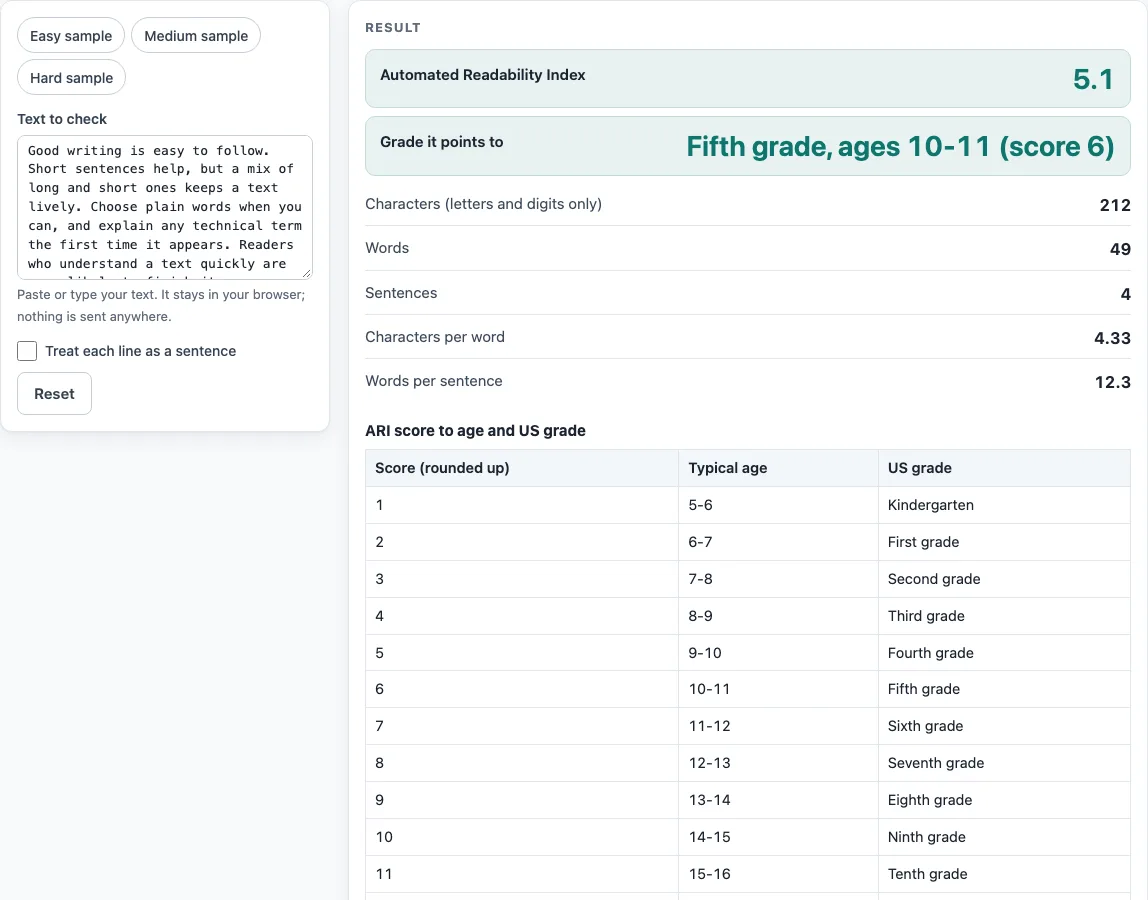
How to use the Automated Readability Index calculator
- Paste your text into the Text to check box. To try the tool first, click one of the sample chips: Easy, Medium or Hard.
- If each line of your text is its own sentence, turn on Treat each line as a sentence. Leave it off for normal paragraphs.
- Read the big Automated Readability Index number. It is shown to one decimal place.
- Check Grade it points to, which gives the grade and age range for the rounded score, such as “Sixth grade, ages 11-12 (score 7)”.
- Review the counts behind the score: Characters (letters and digits only), Words, Sentences, Characters per word and Words per sentence.
- Use the steps shown on the page to follow how the score was reached, and use the ARI score to age and US grade table to compare your score with the full range.
The tool counts paragraphs from blank lines. A single line break counts as a space unless Treat each line as a sentence is on. Text over 200,000 characters is cut, with a warning. If your text has under 20 words or 3 sentences, you will see a “very short text, treat as rough” warning. Use Copy result, Copy link or Print / save as PDF to keep the result, and Reset to return to the sample.
What is the automated readability index?
The automated readability index is a grade-level score based on two averages: characters per word and words per sentence. It was designed so the score could be worked out from simple counts of typed text, without counting syllables. Longer words and longer sentences produce higher scores, and higher scores point to higher grade levels in the table.
What is the ARI formula?
The formula is 4.71 × (characters ÷ words) + 0.5 × (words ÷ sentences) − 21.43. Characters means letters and digits only, with no spaces or punctuation. The formula was published by E. A. Smith and R. J. Senter in 1967, and its constants were restated by Kincaid et al. in 1975. For “The children walked to school together on Monday.”, there are 41 characters, 8 words and 1 sentence, so 41 ÷ 8 = 5.125, 4.71 × 5.125 = 24.14, 0.5 × 8 = 4, and 24.14 + 4 − 21.43 = 6.71, shown as 6.7.
How do I read an ARI score?
Round the score up to the next whole number, then find that number in the table. A score of 6.7 becomes 7, which the table lists as sixth grade, ages 11-12. Scores from 1 to 14 appear in the table. A result below 1 shows “Below the table”, and a result above 14 shows “Above the table”.
Why round up?
Rounding up is the convention for this score: any non-whole number moves to the next whole number. So 10.1 and 10.6 both become 11. The tool follows the same rule, so the default medium sample gives 5.1, which becomes 6 and reads “Fifth grade, ages 10-11 (score 6)”.
Does ARI count syllables?
No. The formula uses only characters, words and sentences, so syllable counts play no part in the score. That means syllable-counting errors cannot change an ARI result.
Are digits counted as characters?
Yes. Characters means letters and digits, so numbers add to the character count while spaces and punctuation do not. “I have 25 apples.” has 13 characters: 11 letters plus the digits 2 and 5. A number such as 1,000.50 is counted as one word.
Is ARI accurate?
ARI is accurate only as a measure of length. It does not measure how hard a text is to understand, and it cannot judge meaning, correctness or whether a text suits a particular reader. Short texts give rough results. For example, “The cat sat on the mat. It was a warm day.” scores −5.8, which is below the table because its words and sentences are very short.
Sources (checked 2026-10-15): Automated readability index (Wikipedia).
Worked examples
| Input | Result |
|---|---|
| Good writing is easy to follow. Short sentences help, but... | ARI 5.1: Fifth grade, ages 10-11 (score 6) |
| The cat sat on the mat. It was a warm day. The dog ran to... | ARI -2.5: Below the table (rounded score -2; the table starts at 1, kindergarten) |
| Organizations frequently underestimate the administrative... | ARI 24.2: Above the table (rounded score 25; the table ends at 14, college) |
Calculated by the tool above; open it with the same values to see each step.
Frequently asked questions
Is this automated readability index calculator free?
Yes. The tool is free, requires no sign-up or account, and runs in your browser. You can paste as many texts as you like, one at a time.
Does the tool store or send the text I paste?
No. Everything runs in your browser, and the text you paste is never uploaded or stored by the site.
How does the tool decide where a sentence ends?
Abbreviations such as Mr., Dr., e.g. and U.S. do not end a sentence by themselves. Neither do initials, decimals or ellipses. A blank line starts a new paragraph, and turning on Treat each line as a sentence makes each line count as a sentence.
Can I check a very long document?
Text over 200,000 characters is cut, and the tool shows a warning. For long documents, check the text in shorter sections.
Does a good ARI score mean my writing is good?
No. ARI measures only sentence length and word length. The tool does not grade, improve or correct writing, and a score does not show whether the writing is clear or correct.
What does the “Grade it points to” row show?
It rounds the ARI score up to the next whole number and looks that number up in the table, giving a US grade and an age range.
Can I share or print my result?
Copy result copies the numbers as text, Copy link copies a web address that reopens the tool with your settings, and Print / save as PDF opens your browser’s print dialog. A very long pasted text is left out of the link.
Related tools
- Gunning Fog index calculator: use it when you want a second grade-level estimate that also considers complex words.
- SMOG index calculator: use it when you want a grade estimate based on polysyllabic words.
- Coleman-Liau index calculator: use it when you want a grade estimate based on letters and sentences rather than syllables.
- Readability formulas compared: read it to see how the different formulas measure text.
- Reading level checker: use it when you want to check the reading level of a passage.
- Flesch-Kincaid calculator: use it when you want a grade estimate based on words per sentence and syllables per word.
- Readability checker: go back to the main page to pick a tool.