Flesch Kincaid Calculator
Paste your text to get its Flesch-Kincaid grade level and reading ease.
Recent
Your last 10 settings, saved only in this browser. Nothing is uploaded.
The Flesch-Kincaid calculator scores how hard a text is to read and reports the result as a US school grade level. Paste your text into the box, and the page shows that grade, a typical reading age, and a Flesch reading ease score. It is free, runs in your browser, and needs no sign-up or account.
It works well as a quick readability test for school material, blog posts, emails, or any writing where you want a rough check of sentence length and word length. Because it is one of several readability formulas, compare its result with other measures before you rely on it. Use it as one check among several, not as the final word on whether a text is good.
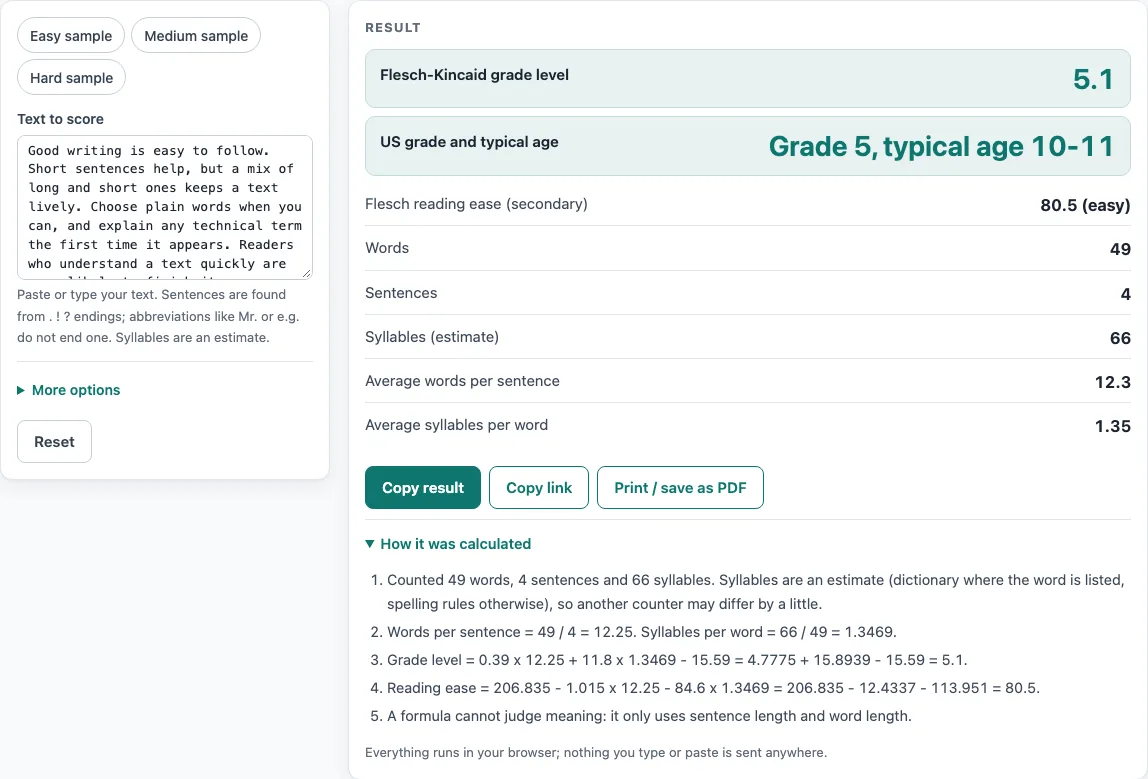
How to use the Flesch-Kincaid calculator
- Paste the text you want to check into the box labelled Text to score. Texts over 200,000 characters are cut at that limit, with a warning.
- Read the large Flesch-Kincaid grade level number, shown to one decimal place.
- Check US grade and typical age for the grade in words, such as “Grade 8, typical age 13-14”.
- Look at Flesch reading ease (secondary) for the score and its band, such as “80.5 (easy)”.
- Review Words, Sentences, Syllables (estimate), Average words per sentence and Average syllables per word to see which numbers shaped the result.
- Open How it was calculated to see both formulas filled in with your own numbers.
To try the tool first, use the presets Easy sample, Medium sample (the default) or Hard sample. If your text is a list, poem, or one item per line, open More options and turn on Treat each line as a sentence. When this is off, a single line break counts as a space and a blank line counts as a paragraph break. Use Copy result to copy the numbers as text, Copy link to copy a web address that reopens the tool with your settings, and Print / save as PDF to keep a record. Reset returns the tool to its starting sample. A very long pasted text is left out of the copied link.
What is the Flesch-Kincaid grade level?
The Flesch-Kincaid grade level is a US school grade calculated from two averages: words per sentence and syllables per word. A result of 8.0 means the text is about at the reading level of an eighth grader.
Kincaid and colleagues derived the formula in 1975 for US Navy training material, and it is a rework of the reading-ease formula Flesch published in 1948. The grade is 0.39 × (words ÷ sentences) + 11.8 × (syllables ÷ words) − 15.59. Longer sentences and longer words both push the grade up.
The tool rounds the grade to the nearest whole grade for its label and adds a typical age of grade + 5 to grade + 6. A grade 8 text therefore gets “typical age 13-14”.
The formula measures only sentence length and word or syllable length. It cannot judge meaning, correctness, vocabulary a particular reader already knows, layout, or whether a text suits a given reader. Two texts with the same averages can score the same while one is much harder to follow.
How do I calculate Flesch-Kincaid by hand?
Count the total words, sentences and syllables in your text, divide to get the two averages, and place them in the formula: 0.39 × (words ÷ sentences) + 11.8 × (syllables ÷ words) − 15.59. The example below uses the text “The cat sat on the mat. The dog ran to the cat.”, which has 12 words, 2 sentences and 12 syllables.
- Words per sentence: 12 ÷ 2 = 6.
- Syllables per word: 12 ÷ 12 = 1.
- Grade: 0.39 × 6 + 11.8 × 1 − 15.59 = −1.45.
Your own syllable counts may differ from the tool’s, because the tool uses a dictionary where it can and a rule-based estimate otherwise.
Sources (checked 2026-10-15): Flesch–Kincaid readability tests (Wikipedia).
Worked examples
| Input | Result |
|---|---|
| The cat sat on the mat. It was a warm day. The dog ran to... | grade -1.0, reading ease 114.9 |
| Good writing is easy to follow. Short sentences help, but... | grade 5.1, reading ease 80.5 |
| Organizations frequently underestimate the administrative... | grade 22.3, reading ease -46.5 |
Calculated by the tool above; open it with the same values to see each step.
Frequently asked questions
What is a good Flesch-Kincaid score?
There is no single good score, because the right level depends on who will read the text. A lower grade means the text is easier by this formula, but the page does not promise any result for a particular reader.
Is the Flesch-Kincaid grade the same as reading ease?
No. The grade is a school level where lower is easier, while Flesch reading ease is a 0-100 style score where higher is easier. In Flesch’s table, a score of 60-70 is labelled “plain English”. Check the direction of each number before you compare them.
Why is my score negative?
Very short sentences made of one-syllable words can push the grade below zero. The tool shows the computed value and labels it “Below kindergarten level”.
How accurate is it?
The scores are estimates. Syllable counts come from the CMU Pronouncing Dictionary where a word is listed and from a spelling-rule estimate otherwise. Short texts give unstable results, because one sentence more or less can move the grade a lot, so the tool warns “very short text: treat as rough” below 3 sentences or 30 words.
Can I check a whole document?
Yes. Paste the whole document into Text to score. Texts over 200,000 characters are cut at 200,000 with a warning, so for a very long document, check it in sections.
Is my text sent anywhere?
No. The calculation runs in your browser, and the site does not upload or store the text you paste.
Related tools
- Flesch reading ease calculator: use this when you want only the 0-100 style score, where higher means easier.
- Flesch reading ease scale: use this to see what each reading ease band means.
- Flesch-Kincaid formula calculator: use this to work through the grade formula with your own numbers.
- Readability formulas compared: use this to see how Flesch-Kincaid differs from other readability formulas.
- Reading level checker: use this to check the reading level of a text in a different way.
- What is reading level: use this to learn what reading level means before you interpret a score.
- Readability checker: use this to return to the main tool page.