Flesch Kincaid Formula Calculator
Enter your counts and watch the grade level and reading ease formulas worked out step by step.
Recent
Your last 10 settings, saved only in this browser. Nothing is uploaded.
The Flesch-Kincaid formula turns sentence length and word length into a US school grade level. The Flesch reading ease formula turns the same two averages into a score, where higher means easier to read. This page’s calculator runs both formulas from your counts of words, sentences and syllables, and shows each one filled in step by step. It runs in your browser, is free, and needs no sign-up.
You can also work backward. Enter a target grade and your sentence length, and the tool returns the syllables per word that grade would need. Scores are estimates, because syllable counts come from a dictionary or a rule-based guess.
How to use the Flesch formula calculator
- Pick a mode: “Totals (words, sentences, syllables)”, “Averages (words per sentence, syllables per word)”, or “Syllables per word needed for a target grade”.
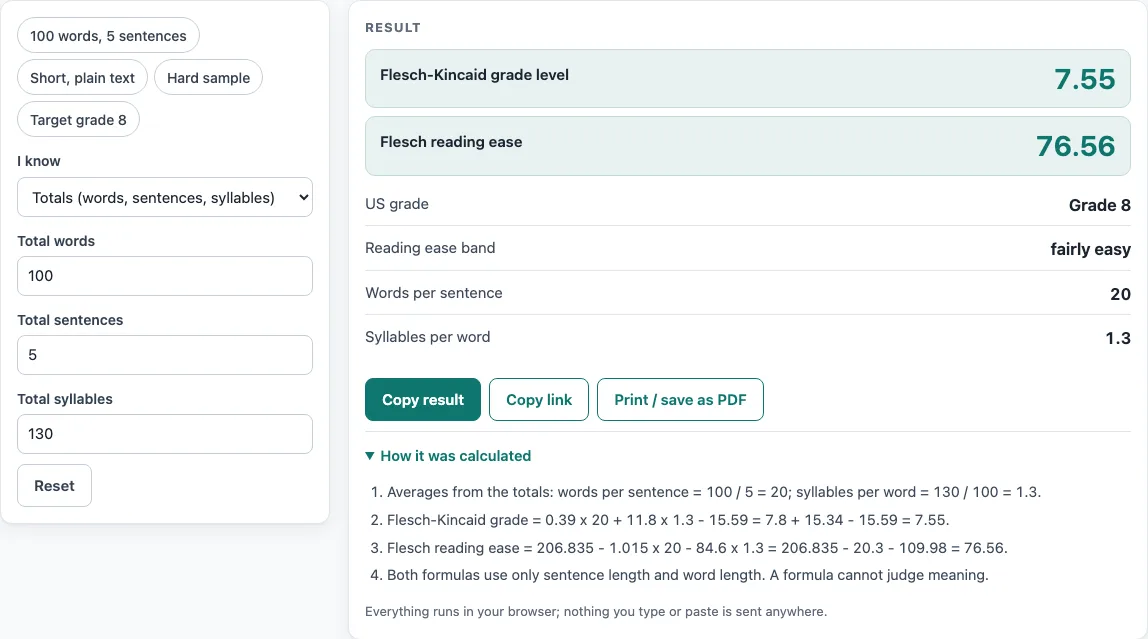
- In Totals mode, type your counts into “Total words”, “Total sentences” and “Total syllables”. The defaults are 100, 5 and 130.
- In Averages mode, type your figures into “Words per sentence” and “Syllables per word”.
- In target mode, type a value into “Target grade level” and another into “Words per sentence”.
- Check your entries against the rules. Numbers must be positive, sentences cannot exceed words, and syllables cannot be fewer than words. Words per sentence and syllables per word cannot be below 1.
- Read “Flesch-Kincaid grade level” and “Flesch reading ease”. Also read “US grade” and “Reading ease band”.
- In Totals mode, check “Words per sentence” and “Syllables per word”, the two averages both formulas use. In target mode, read “Syllables per word needed” first. It shows three decimals.
- Look at the worked steps to see both formulas with your numbers filled in.
- Read any warning. A negative grade shows “below kindergarten level”. Reading ease above 100 or below 0 is flagged. In target mode, “Impossible target” appears when the result is below 1, and “Very high” appears above 2.5.
The presets fill the fields for you: “100 words, 5 sentences”, “Short, plain text” (9 words per sentence, 1.3 syllables per word), “Hard sample” (120 words, 4 sentences, 210 syllables), and “Target grade 8” (15 words per sentence). Try one before entering your own counts.
What is the Flesch-Kincaid formula?
The Flesch-Kincaid formula estimates the US school grade level needed to read a text. It uses two averages: words per sentence and syllables per word. The grade formula is 0.39 x (words / sentences) + 11.8 x (syllables / words) - 15.59. Kincaid, Fishburne, Rogers and Chissom published it in 1975 as Research Branch Report 8-75.
Longer sentences and longer words both raise the grade. The syllable weight is much larger, though. One extra syllable per word adds 11.8 grades, while one extra word per sentence adds 0.39.
Take 100 words, 5 sentences and 130 syllables. That gives 20 words per sentence and 1.3 syllables per word. The grade is 0.39 x 20 + 11.8 x 1.3 - 15.59 = 7.8 + 15.34 - 15.59 = 7.55, which the tool labels “Grade 8”.
Target mode solves the same formula for syllables per word: (grade + 15.59 - 0.39 x words per sentence) / 11.8. For grade 8 at 15 words per sentence, that is (8 + 15.59 - 5.85) / 11.8 = 1.503. A target can also be impossible. Grade -5 at 5 words per sentence needs 0.732 syllables per word. That is below 1, and every word has at least one syllable.
What is the Flesch reading ease formula?
The Flesch reading ease formula, published by Flesch in 1948, gives a score instead of a grade: 206.835 - 1.015 x (words / sentences) - 84.6 x (syllables / words). Higher scores mean easier text. Here one extra syllable per word subtracts 84.6 points, and one extra word per sentence subtracts 1.015.
With the same example, the score is 206.835 - 20.3 - 109.98 = 76.555. The tool shows 76.56 and labels it “fairly easy”. The “Hard sample” preset (120 words, 4 sentences, 210 syllables) gives a grade of 16.76 and a reading ease of 28.34, labelled “very difficult”.
These formulas only measure sentence length and word or syllable length. They cannot judge meaning, correctness, or whether a text suits a particular reader. Syllable counts come from a dictionary where the word is listed and a rule-based estimate otherwise, so every score is an estimate.
Sources (checked 2026-10-15): Flesch–Kincaid readability tests (Wikipedia).
Worked examples
| Input | Result |
|---|---|
| 100 words, 5 sentences, 130 syllables | grade 7.55, reading ease 76.56 |
| 9 words per sentence, 1.3 syllables per word | grade 3.26, reading ease 87.72 |
| 120 words, 4 sentences, 210 syllables | grade 16.76, reading ease 28.34 |
| grade 8, 15 words per sentence | 1.503 syllables per word |
Calculated by the tool above; open it with the same values to see each step.
Frequently asked questions
How do I calculate it by hand?
Count the words, sentences and syllables in your text. Divide words by sentences, and divide syllables by words. Put those two averages into the grade formula or the reading ease formula and work through the arithmetic. The calculator shows these same steps with your numbers filled in.
What do the numbers 0.39 and 11.8 mean?
They are weights that Kincaid and colleagues fitted for sentence length and word length. The 0.39 applies to words per sentence, and the 11.8 applies to syllables per word. Word length therefore changes the grade far more than sentence length does.
What syllables per word do I need for grade 8?
It depends on your sentence length. At 15 words per sentence, you need about 1.50 syllables per word, which the target mode gives as 1.503. Longer sentences need fewer syllables per word to reach the same grade, and shorter sentences allow more.
Which is harder, grade or ease?
A higher grade means harder text. A higher reading ease means easier text, so the two scales run in opposite directions. The “Hard sample” gives grade 16.76 and ease 28.34, and both point to difficult text.
Can a score go below 0 or above 100?
Yes. Very short sentences with short words can push reading ease above 100, and very long sentences with long words can push it below 0. The tool shows a warning in either case.
Does the calculator upload my text?
Everything runs in your browser. The text you paste is never uploaded or stored by the site.
Related tools
- Flesch-Kincaid calculator: Use it when you want the grade level from a text with its own counts.
- Flesch reading ease calculator: Use it when you need only the 0 to 100 ease score.
- Flesch reading ease scale: Use it to see what each score range means in plain terms.
- Readability formulas compared: Use it to see how the Flesch formulas differ from other measures.
- Reading level checker: Use it when you want a reading level for a piece of writing.
- What is reading level: Use it for a plain explanation of the idea before you calculate.
- Readability checker: Use it to return to the main tool on the site.