Flesch Reading Ease Scale
Enter a reading ease score, or paste a text, to see which band it falls in.
Recent
Your last 10 settings, saved only in this browser. Nothing is uploaded.
How to use the Flesch reading ease scale
- Under “Start from”, choose “A score I already have” or “A text I paste”.
- For a score, type a number into “Reading ease score”. It starts at 65, and commas are allowed. The field accepts -1000 to 1000. Outside 0 to 100, a warning tells you the scale is not capped.
- For text, type or paste your writing into “Text”. The tool computes the score first.
- To count each line as its own sentence, tick “Treat each line as a sentence” under “More options”.
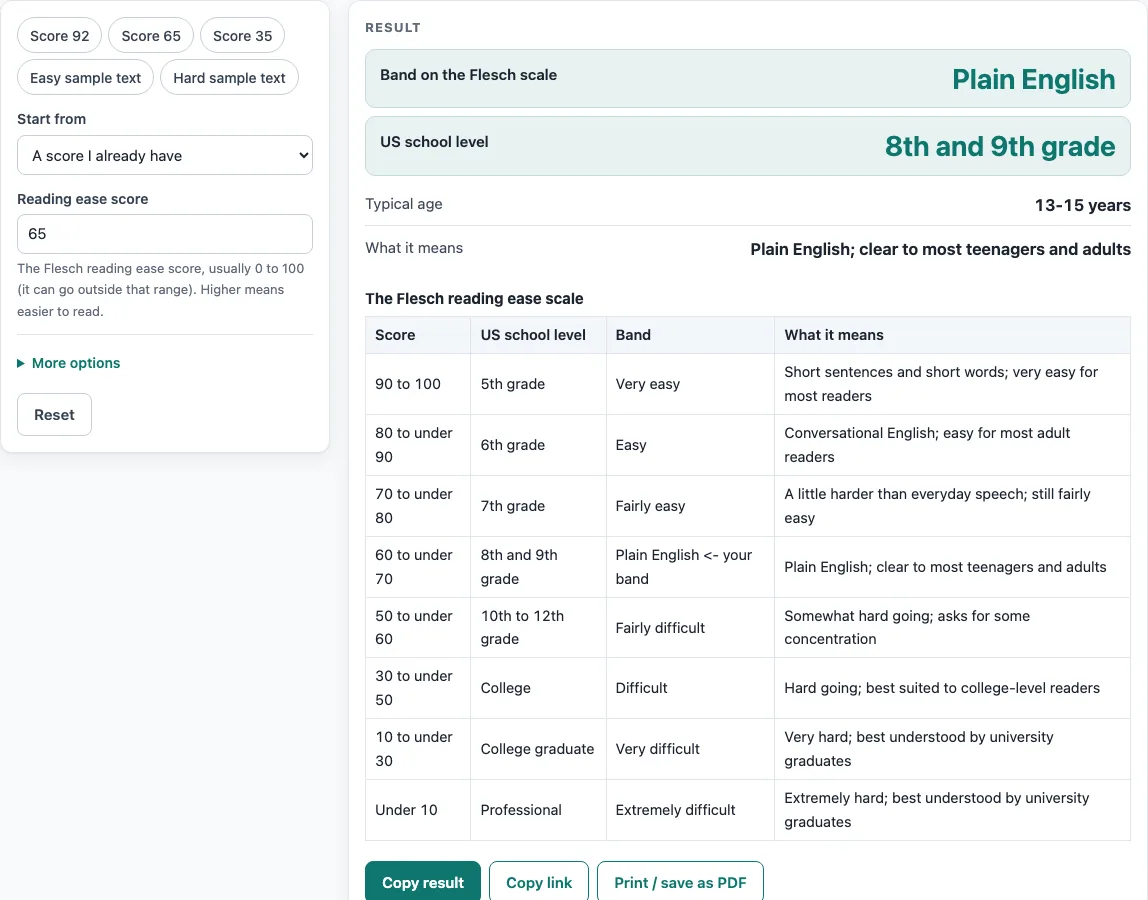
- Read the results: “Band on the Flesch scale”, “US school level”, “Typical age”, and “What it means”. In text mode, the “Flesch reading ease score” row appears first, followed by the formula steps. For example, a score of 65 gives “Plain English”, “8th and 9th grade”, and “13-15 years”.
- Check the full eight-row table. Your band is marked “<- your band”.
The presets “Score 92”, “Score 65”, “Score 35”, “Easy sample text”, and “Hard sample text” fill the inputs with example values, so you can compare how each band reads. Use Copy result to copy the numbers as text, Copy link to copy a web address that reopens the tool with your settings, and Print / save as PDF to keep a record. Reset returns the tool to its starting sample. A very long pasted text is left out of the copied link.
What is the reading ease scale?
The reading ease scale has eight bands, from “Very easy” (90 to 100) down to “Extremely difficult” (under 10). The table on this page lists each band’s score range, US school level, band name, and a short description.
The bands are: 90 to 100 Very easy (5th grade); 80 to under 90 Easy (6th grade); 70 to under 80 Fairly easy (7th grade); 60 to under 70 Plain English (8th and 9th grade); 50 to under 60 Fairly difficult (10th to 12th grade); 30 to under 50 Difficult (college); 10 to under 30 Very difficult (college graduate); and under 10 Extremely difficult (professional). Typical ages for the school-grade bands run from the first grade plus 5 to the last grade plus 6. Scores above 100 are shown in the very easy band.
Published tables print boundary scores in two bands, such as 80 in both “Easy” and “Fairly easy”. This tool puts a boundary score in the easier band, so a score of 80 is “Easy”, not “Fairly easy”.
What does a Flesch reading ease score measure?
The score comes from Rudolf Flesch’s 1948 reading-ease formula, published in “A new readability yardstick” in the Journal of Applied Psychology. In text mode, the tool calculates it as 206.835 minus 1.015 times words per sentence, minus 84.6 times syllables per word. Longer sentences and more syllables per word both lower the score.
The formula only measures sentence length and syllables per word. It cannot judge meaning, correctness, or whether a text suits a particular reader. Syllable counts come from a dictionary where the word is listed, and from a rule-based estimate otherwise, so every score is an estimate.
What does a Flesch score of 50 mean?
A score of 50 is the start of the “Fairly difficult” band, which covers 50 to under 60. The US school level for that band is 10th to 12th grade, and the typical age is 15 to 18 years. Because a boundary score goes to the easier band, 50 belongs to “Fairly difficult” rather than “Difficult”.
How does the Flesch-Kincaid grade level differ from the reading ease score?
“Flesch-Kincaid score” can mean two different things. One is the reading ease score, where higher means easier. The other is the Flesch-Kincaid grade level, a US school grade where lower means easier. It is calculated as 0.39 times words per sentence, plus 11.8 times syllables per word, minus 15.59 (Kincaid et al., 1975).
The two numbers differ for the same text. The Medium sample has an ease score of 80.5, which corresponds to a grade level of 5.1 on the grade formula. The tool’s text mode places the same score in the “6th grade” band, with a typical age of “11-12 years”. Check which measure a source uses before you compare numbers.
Sources (checked 2026-10-15): Flesch–Kincaid readability tests (Wikipedia).
Worked examples
| Input | Result |
|---|---|
| score 95 | Very easy (score 95.0) |
| score 65 | Plain English (score 65.0) |
| score 35 | Difficult (score 35.0) |
| a pasted text | Easy (score 80.5) |
Calculated by the tool above; open it with the same values to see each step.
Frequently asked questions
Flesch reading ease score meaning: what is a good score?
There is no single right score. The 60 to 70 range is “Plain English”, which the tool describes as clear to most teenagers and adults. Higher scores are easier, so the score that suits you depends on who will read the text.
Flesch Kincaid score meaning: ease or grade?
It can mean the reading ease score, where 0 to 100 and higher is easier, or the Flesch-Kincaid grade level, a US school grade where lower is easier. Confirm which one is being used before comparing two numbers.
Can I get the score from my own text?
Yes. Under “Start from”, choose “A text I paste”, then enter your text into “Text”. The score appears as the first result row, with the formula steps below it.
Why is my score above 100?
Scores above 100 come from very simple text, with short sentences and few syllables per word. The scale is not capped, so the tool shows these scores in the very easy band.
What grade level is a score of 70?
A score of 70 falls in the “Fairly easy” band, which corresponds to 7th grade. The typical age for this band is 12 to 13 years.
Can I share or print my result?
Copy result copies the numbers as text, Copy link copies a web address that reopens the tool with your settings, and Print / save as PDF opens your browser’s print dialog. A very long pasted text is left out of the link.
Related tools
- Flesch-Kincaid calculator: Use this when you want the Flesch-Kincaid grade level for a text.
- Flesch reading ease calculator: Use this when you want to work out the reading ease score for a text.
- Flesch-Kincaid formula calculator: Use this when you want to see the grade-level formula applied step by step.
- Readability formulas compared: Use this when you want to see how different formulas measure readability.
- Reading level checker: Use this when you want to check the reading level of a text.
- What is reading level: Use this when you want a plain explanation of reading level before you check a text.
- Readability checker: Use this when you want to return to the main page and check a text.