Gunning Fog Index Calculator
Paste your text to get its Gunning Fog index and the complex words behind it.
Recent
Your last 10 settings, saved only in this browser. Nothing is uploaded.
The Gunning Fog index is a readability score that estimates the US school grade level a reader needs to understand a piece of writing. This gunning fog index calculator works on any text you paste in and shows the score, the number of complex words, and the sentence and word totals behind it.
The tool is free, with no sign-up and no account. It runs in your browser, so the text you paste is never uploaded or stored by the site. Use it to see how long your sentences are and how many long words they contain. It measures sentence and word length only. It does not judge meaning or correctness, and it does not grade your writing.
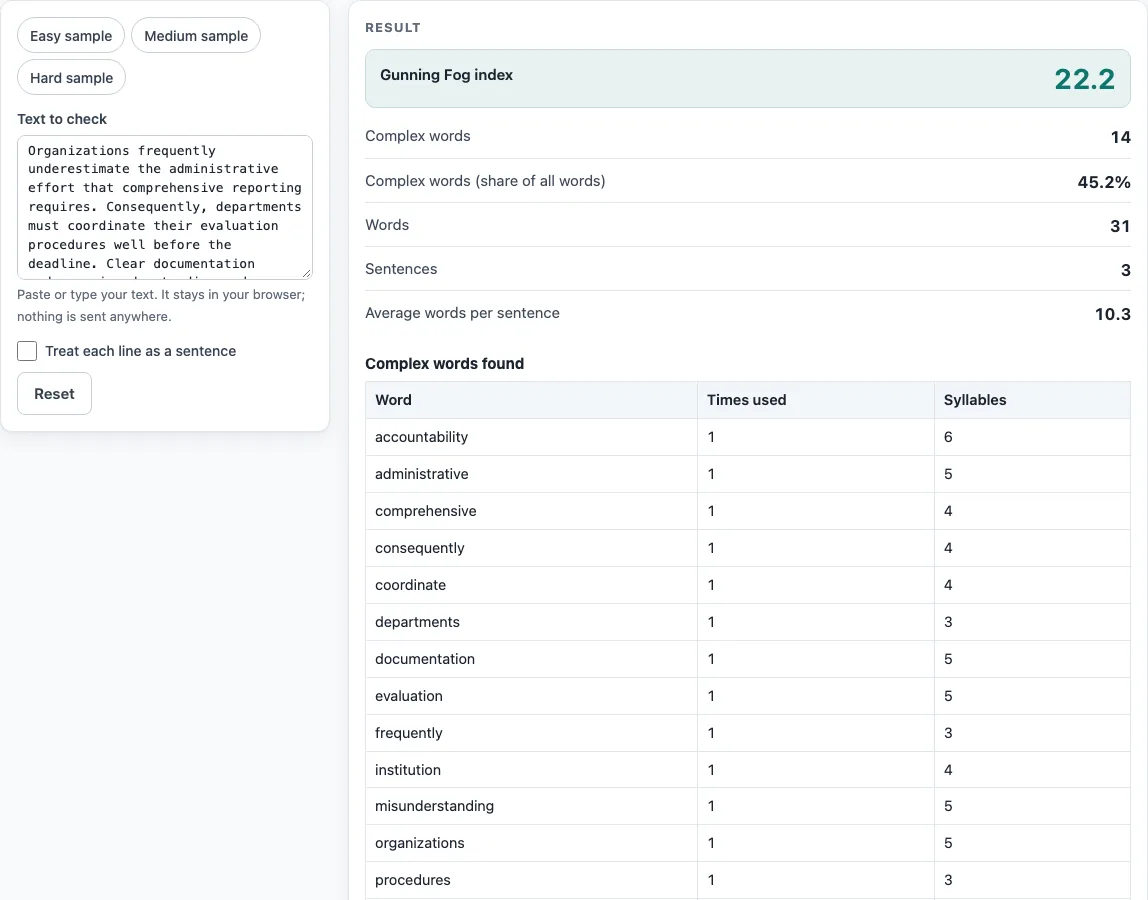
How to use the Gunning Fog Index Calculator
Follow these steps to get a fog index for your own text.
- Paste your text into the Text to check box. A blank line starts a new paragraph. A single line break counts as a space. Texts over 200,000 characters are cut, and you will see a warning.
- If each line is a separate sentence, such as a list of short items, turn on Treat each line as a sentence. Leave it off for normal prose.
- Read the Gunning Fog index number, shown large with one decimal place.
- Check Complex words and Complex words (share of all words) to see how much of the score comes from long words.
- Compare Words, Sentences and Average words per sentence to see how sentence length adds to the score.
- Open How it was calculated to see the formula filled in with your numbers.
- Review the Complex words found table. It lists each distinct word with its Times used and Syllables, most frequent first, up to 100 rows.
- Read any warnings. A text under 20 words or 3 sentences gets a “very short text, treat as rough” warning.
To try the tool first, click Easy sample, Medium sample or Hard sample. The default text is the hard sample, which scores 22.2 with 14 complex words.
What is the Gunning Fog index?
The Gunning Fog index is a readability score that gives a US school grade level, meaning the schooling a reader needs to understand a text. It combines two measures: the average length of sentences, and the share of words with three or more syllables.
Robert Gunning described the method in The Technique of Clear Writing (McGraw-Hill, 1952). Gunning’s method uses a sample of about 100 words. This tool analyses the whole text you paste, with no sampling.
A complex word is a word with three or more syllables, with three exceptions:
- Hyphenated words, such as “well-known”, are not counted.
- Proper nouns are not counted. A capitalised word that is not the first word of its sentence is treated as a proper noun, so “Washington” in “We visited Washington yesterday.” is not counted.
- Words ending in -ed, -es or -ing are not counted when the stem (the word without the ending) has fewer than three syllables. “Visiting” is not counted because it reaches three syllables only through -ing. “Remembering” is counted because its stem, “remember”, already has three.
Gunning also excludes familiar jargon, but the tool cannot detect it, so jargon is counted when it has three or more syllables.
Syllable counts are estimates. The tool uses the CMU Pronouncing Dictionary (first pronunciation) where a word is listed, and a rule otherwise. The rule agrees with the dictionary on 90% of 117k words. Numerals count as one syllable.
What is the Gunning Fog index formula?
The formula is 0.4 × [(words ÷ sentences) + 100 × (complex words ÷ words)]. The first part is the average number of words per sentence. The second part is the percentage of complex words. The 0.4 scales the total to a grade level.
Take the sentence “The children walked to school together on Monday.” It has 8 words, 1 sentence and 1 complex word (“together”).
- Average sentence length: 8 ÷ 1 = 8
- Complex-word term: 100 × (1 ÷ 8) = 12.5
- Total: 0.4 × (8 + 12.5) = 8.2
A longer sentence raises the first part. Each extra complex word raises the second part.
Sources (checked 2026-10-15): Gunning fog index (Wikipedia).
Worked examples
| Input | Result |
|---|---|
| Organizations frequently underestimate the administrative... | Fog index 22.2 (14 complex words in 31) |
| The cat sat on the mat. It was a warm day. The dog ran to... | Fog index 2.9 (0 complex words in 29) |
| Good writing is easy to follow. Short sentences help, but... | Fog index 6.5 (2 complex words in 49) |
Calculated by the tool above; open it with the same values to see each step.
Frequently asked questions
What is a good Gunning Fog score?
A common guideline is an index under 12 for a text meant for a wide audience, and under 8 for a text that needs near-universal understanding. The scale runs from 6 (sixth grade) to 17 (college graduate). These are guides, not rules, so choose a target based on your readers.
How many words should the sample have?
Gunning used a sample of about 100 words. This tool analyses the whole text you paste, so you do not need to choose a sample size. Very short text, under 20 words or 3 sentences, gets a “very short text, treat as rough” warning.
What does a fog index of 12 mean?
A fog index of 12 matches the reading level of a United States high school senior, who is around 18 years old. A text with a score of 12 is generally harder for younger readers than one scoring 8.
How is it different from Flesch-Kincaid?
The Fog index counts only long words, meaning words with three or more syllables. Flesch-Kincaid uses the average number of syllables per word instead. You can compare the two with the Flesch-Kincaid calculator.
Can the fog index tell me if my writing is good?
No. The index reflects sentence length and word length only. It cannot judge meaning, correctness, or whether a text suits a particular reader. Syllable counts are estimates, so treat the score as a guide.
Related tools
- SMOG index calculator: use it when you want a second grade-level estimate that also depends on counting long words.
- Automated Readability Index calculator: use it when you want a score based on characters per word rather than syllables.
- Coleman-Liau index calculator: use it when you want a score based on letters and sentences rather than syllables.
- Readability formulas compared: use it to see how the main formulas differ before you pick one.
- Reading level checker: use it when you want to check the reading level of a text in a different way.
- Flesch-Kincaid calculator: use it when you want a score based on average syllables per word.
- Readability checker: return to the main page to check your text with the other tools.