Haiku Syllable Counter
Write your poem to count the syllables on each line and check them against 5-7-5.
Recent
Your last 10 settings, saved only in this browser. Nothing is uploaded.
The Haiku syllable counter checks whether each line of your poem has the syllable count of a haiku, which is 5-7-5 by default. Paste a poem, and the page counts the syllables in every line and compares each one with the target. It also checks tanka (5-7-5-7-7), senryu (5-7-5), and a custom pattern you set.
The counter runs in your browser, so the text you paste is never uploaded or stored by the site. It is free, with no sign-up or account.
The tool counts syllables only. It does not judge imagery, season words, cutting or meaning, so use it to check line lengths, not to decide whether a poem is good.
How to use the Haiku syllable counter
- Open the “Form” menu and choose Haiku, Tanka, Senryu or Custom. Haiku and Senryu both use the 5-7-5 target.
- If you chose Custom, type your pattern into the “Pattern” field that appears, for example 5-7-5 or 3,5,3.
- Type or paste your poem into the “Poem” box, with one line per line of verse. Blank lines are skipped, and the tool accepts up to 100 lines.
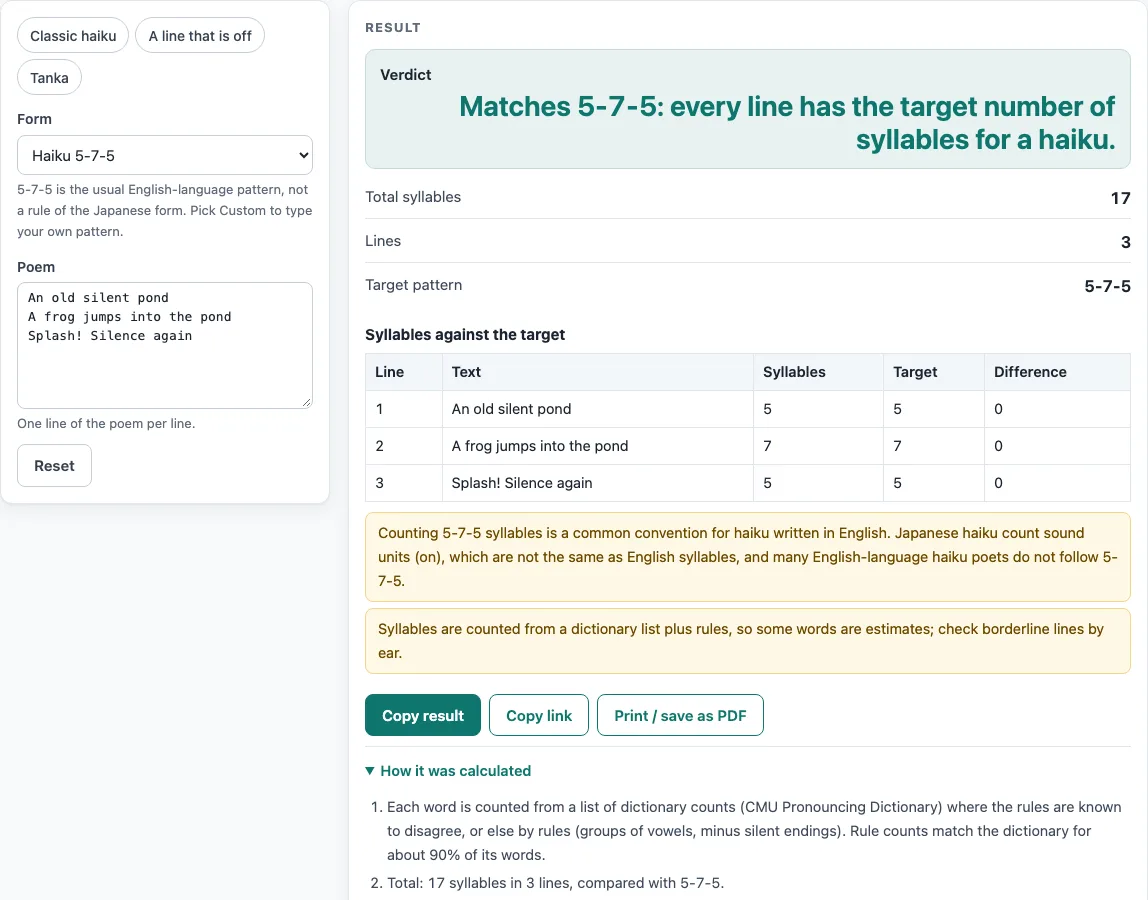
- Read the “Verdict” box first. It gives the result in one large statement and names any line that is off.
- Check the “Total syllables”, “Lines” and “Target pattern” outputs to confirm the poem has the number of lines you expected.
- Read the table “Syllables against the target”. Each row shows the “Line”, “Text”, “Syllables”, “Target” and “Difference”. A Difference of +1 means one syllable too many, -1 means one too few, and 0 means the line matches.
- Edit any line that is off and check the table again.
To see examples of a match, a mismatch and a tanka, use the presets “Classic haiku”, “A line that is off” and “Tanka”. Use Copy result to copy the numbers as text, Copy link to copy a web address that reopens the tool with your settings, and Print / save as PDF to keep a record. Reset returns the tool to its starting sample. A very long pasted text is left out of the copied link.
How many syllables are in a haiku?
English haiku are traditionally taught as 17 syllables in three lines of 5, 7 and 5. The Japanese form does not count English syllables. It counts sound units called on, and the Haiku Society of America (HSA) says that about twelve English syllables approximates the length of seventeen Japanese on.
The HSA’s 2004 definitions say that “Most haiku in English consist of three unrhymed lines of seventeen or fewer syllables, with the middle line longest.” Its earlier 1973 and 1976 definitions said that “Rarely is a haiku [in English] longer than 17 syllables.” So 17 is a rough guide for English haiku, not a fixed count.
The tool counts syllables with spelling rules, and uses counts from the CMU Pronouncing Dictionary (BSD-2-Clause) for the words where those rules are known to go wrong. The rules agree with the dictionary about 90% of the time, so some counts are estimates, and the page warns about this.
Does a haiku have to be 5-7-5?
No. The 5-7-5 pattern is a common convention for haiku written in English, not a requirement of the Japanese form. The HSA states that “today’s poets use a variety of line lengths and arrangements.”
The 5-7-5 pattern is a useful check because it shows how a poem’s lines compare with the convention. The short pond poem “An old silent pond / A frog jumps into the pond / Splash! Silence again” counts 5, 7, 5, so the tool returns “Matches 5-7-5.”
A poem that misses 5-7-5 is reported as not matching that pattern. The tool checks only syllable counts, so it does not say that the poem is not a haiku.
Sources (checked 2026-10-15): Haiku Society of America, Definitions 2004; CMU Pronouncing Dictionary.
Worked examples
| Input | Result |
|---|---|
| An old silent pond ... (5-7-5) | matches |
| Snow falls on the roof ... (5-7-5) | does not match: Line 2 has 6 syllables, target 7. |
| The evening is still ... (5-7-5-7-7) | matches |
| Cat sat down ... (3-5-3) | does not match: Line 3 has 2 syllables, target 3. |
Calculated by the tool above; open it with the same values to see each step.
Frequently asked questions
How do I count syllables in a haiku line?
Paste the whole poem into the “Poem” box, one line per line of verse. The “Syllables” column in the table shows the count for each line. You can check any count yourself by saying the line aloud and counting the beats.
Why is my line one syllable off?
A word in that line may have been counted by spelling rules, which are not always right. For example, “Snow falls on the roof / Soft and quiet all night / Morning light returns” counts 5, 6, 5, and the verdict reads “Line 2 has 6 syllables, target 7.” Read the line aloud, check the word that is giving the wrong count, and change the wording if you want the line to reach the target.
What is a tanka?
A tanka is a five-line poem. In English it is often written with 5-7-5-7-7 syllables, which makes 31 in total. The tool’s Tanka form uses this pattern, and the example “The evening is still / A lantern glows in the glass / Someone waits for me / The road is long but I walk / Slowly toward my own gate” counts 5, 7, 5, 7, 7 and matches.
What is the difference between haiku and senryu?
Syllable counts cannot tell the two forms apart. The tool uses the same 5-7-5 target for both Haiku and Senryu. It checks only syllable counts.
Can I use my own pattern?
Yes. Choose “Custom” from the “Form” menu, then type your pattern into the “Pattern” field. For example, the poem “Cat sat down / The dog ran home soon / All sleep” counts 3, 5, 2 against a 3-5-3 pattern, and the verdict reads “Line 3 has 2 syllables, target 3.”
Related tools
- Syllable counter: use it when you want syllable counts for a passage of text rather than the lines of a poem.
- Syllable checker: use it when you want to check syllable counts in your own writing.
- Sentence counter: use it when you need to count sentences rather than syllables.
- Flesch reading ease calculator: use it for a reading-ease estimate, which is based only on sentence length and word length, so it cannot judge meaning.
- Flesch-Kincaid calculator: use it for a grade-level estimate based on sentence and syllable counts.
- Readability checker: use it to see readability scores for a longer text.