Passive Voice Checker
Paste your text to find passive voice phrases and see how many sentences use them.
Recent
Your last 10 settings, saved only in this browser. Nothing is uploaded.
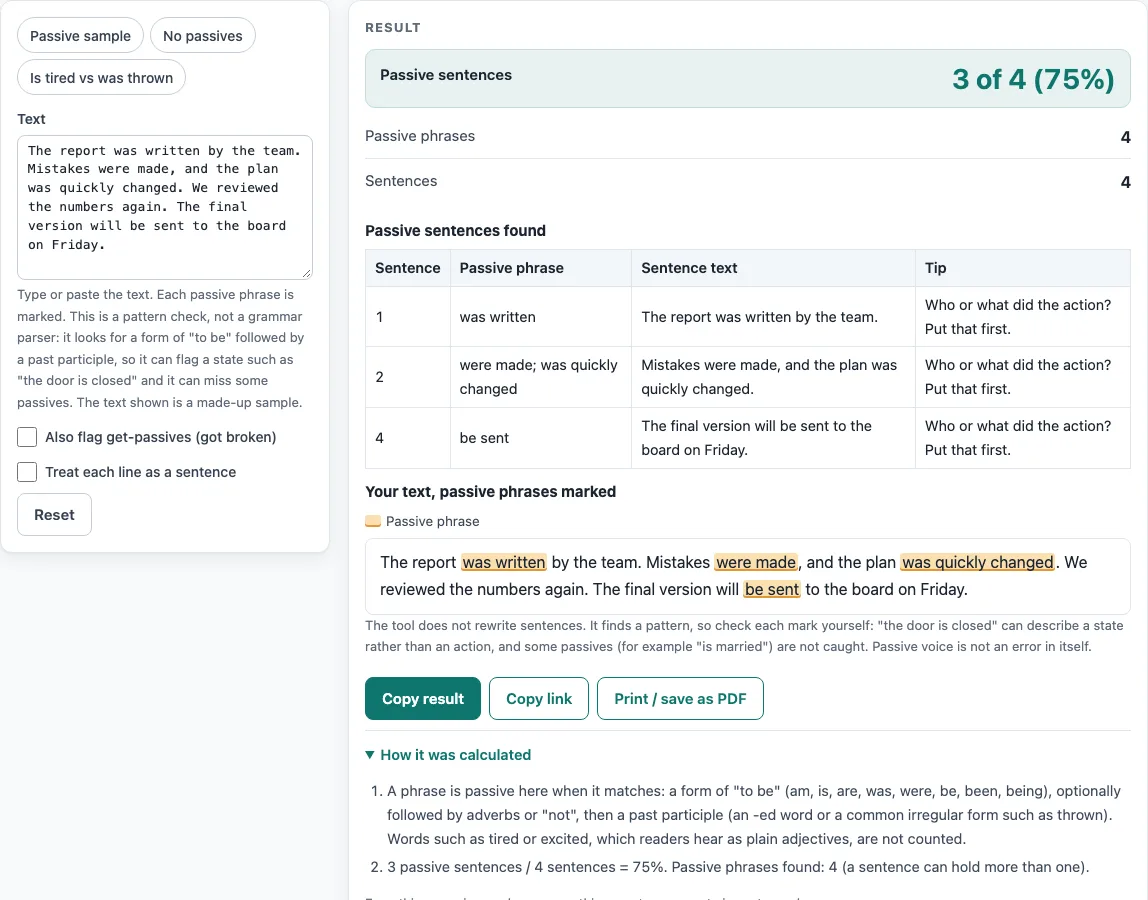
How to use the Passive voice checker
- Click into the box labelled “Text” and paste your writing. The page analyzes up to 200,000 characters and shows a warning if your text is longer.
- Leave “Also flag get-passives (got broken)” off to check standard passives only. Turn it on to include phrases such as “got broken”.
- Turn on “Treat each line as a sentence” if each line of your text is one sentence. If it is off, a single line break inside a paragraph counts as a space.
- Read the “Passive sentences” result, which shows a count such as “3 of 4 (75%)”. Beside it, “Passive phrases” and “Sentences” give the other totals.
- Open the “Passive sentences found” table. It lists each flagged sentence with its Sentence number, Passive phrase, Sentence text, and Tip.
- Check “Your text, passive phrases marked” to see each phrase highlighted in its place in your text.
Both checkboxes are off by default. To see how the checker behaves, try one of the presets: “Passive sample”, “No passives”, or “Is tired vs was thrown”. The table lists up to 300 flagged sentences, but the counts cover all of the text analyzed. Use Copy result, Copy link or Print / save as PDF to keep the result, and Reset to return to the sample.
What is a passive voice checker?
A passive voice checker looks for a pattern rather than understanding grammar. The pattern is a form of “to be” followed by a past participle, such as “was written” or “were made”. Up to three optional adverbs or the word “not” can sit between the two, as in “was quickly changed”.
A passive sentence has a subject that receives the action. “The report was written by the team” is passive. “The team wrote the report” is active, because the subject does the action. The checker recognises participles in two ways: any -ed word of four or more letters, or a standard irregular form such as thrown, made, written, sent, or done. It skips a fixed list of adjective-like words, such as tired, excited, and married, and words that end in -ed but are not participles, such as need, speed, and red.
The percentage is passive sentences divided by all sentences. A sentence with two passive phrases counts once as a passive sentence and twice in the phrase count. Abbreviations such as “Dr.” and “e.g.”, initials, decimals, and ellipses do not end a sentence, so they do not throw off the count.
Is passive voice always wrong?
No. Passive voice is not always wrong, and this tool only counts and marks it. The US federal plain-language guidance “Use active voice” says active voice “makes it clear who is supposed to do what,” while passive sentences “often do not identify who is performing the action.” The same guidance adds that “In a few instances, passive voice may be appropriate,” such as when the law is the actor or when it does not matter who acts. Its example pair is “The lake was polluted by the company.” and “The company polluted the lake.” The shorter, active version names the actor first, which is the question the table’s Tip asks you to consider.
Sources (checked 2026-10-15): Federal plain language guidelines (digital.gov).
Worked examples
| Input | Result |
|---|---|
| The report was written by the team. Mistakes were made, and the plan was quickly change... | 3 of 4 sentences passive; 4 passive phrases |
| We reviewed the numbers. The team wrote a clear report. Anna sent it to the board on Fr... | 0 of 4 sentences passive; 0 passive phrases |
| She is tired. The ball was thrown. The door is closed. A tired team lost. | 2 of 4 sentences passive; 2 passive phrases |
| The window got broken. The vase was dropped. | 2 of 2 sentences passive; 2 passive phrases |
Calculated by the tool above; open it with the same values to see each step.
Frequently asked questions
Can it fix passive voice?
No. The tool marks passive phrases and shows the same hint for each flagged sentence: “Who or what did the action? Put that first.” Rewriting is left to you.
Why was “the door is closed” flagged?
The pattern cannot tell a state from an action, so “is closed” matches even when it describes how the door is. The page says it is a pattern check. By contrast, “She is tired.” is not flagged because “tired” is treated as a plain adjective.
How many passive sentences is too many?
The page does not name a limit. It shows the percentage of passive sentences so you can judge the number against your own purpose.
What are get-passives?
Get-passives use get, gets, got, getting, or gotten followed by a past participle, as in “The window got broken.” Turn on “Also flag get-passives (got broken)” to count them. The option is off by default, and the page warns that these are not always passive.
Can the checker miss passive sentences?
Yes. Because it matches a pattern rather than parsing grammar, it can miss a passive it does not recognise, such as “is married.” Check the results against your own reading of the text.
Related tools
- Active voice checker: use it to find the active sentences in the same text, so you can compare how your subjects act.
- Plain language examples and checker: use it to see rewritten examples of wordy or unclear sentences.
- Readability checker: use it for estimates based only on sentence length and word or syllable length, since formulas cannot judge meaning.
- Average sentence length calculator: use it to find the mean number of words per sentence in your draft.
- Sentence counter: use it when you only need the number of sentences in a passage.
- Reading level checker: use it for a reading-level estimate, keeping in mind that it measures length and not meaning.