Plain Language Examples and Checker
Paste your text to mark long sentences, passive phrases and wordy words.
Recent
Your last 10 settings, saved only in this browser. Nothing is uploaded.
Plain language examples show wordy writing next to plainer wording, and this checker finds the same things in your own text. It marks long sentences, passive phrases, and wordy words, and suggests plainer alternatives from the US federal plain-language guidelines. It runs in your browser, is free, and needs no sign-up. The page also includes plain language examples before and after, so you can see how common wordy phrasing can be rewritten in shorter, more familiar words.
Paste your own text to see what the tool flags, or load one of the built-in samples first to see how the results look. The tool counts and compares; it does not judge whether your writing is clear or suits your readers. Read the sections below to learn what each result means and where its limits are.
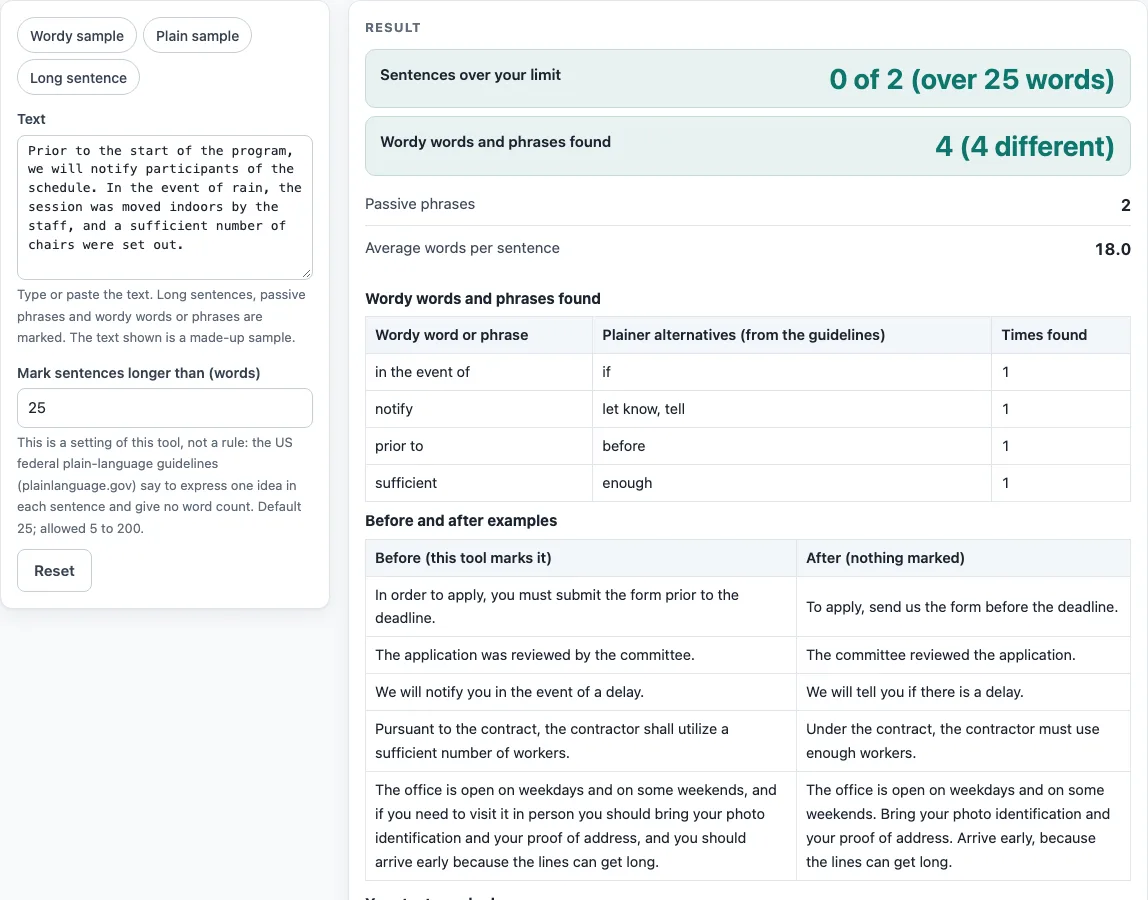
How to use the Plain language checker
- Paste your text into the Text box. Any length works, up to 200,000 characters.
- Optionally, change Mark sentences longer than (words). It accepts a whole number from 5 to 200. Leave it blank to use the default of 25.
- Read the four summary results: Sentences over your limit, Wordy words and phrases found, Passive phrases, and Average words per sentence.
- Open the Wordy words and phrases found table. It lists each Wordy word or phrase, its Plainer alternatives (from the guidelines), and the Times found.
- Compare your text with the Before and after examples section, which shows five pairs.
- Scroll to Your text, marked to see exactly which sentences and words were flagged.
To try the tool before using your own text, click one of the presets: Wordy sample, Plain sample, or Long sentence. With the Wordy sample, the tool reports 0 sentences over the limit, 4 wordy items, 2 passive phrases, and an average of 18.0 words per sentence. The Plain sample shows 0 for each result and the note “Nothing was marked.”
If your text is very long, the analysis covers up to 200,000 characters and shows a warning past that point. The marked view shows the first 1,500 sentences. Use Copy result, Copy link or Print / save as PDF to keep the result, and Reset to return to the sample.
What is plain language?
Plain language is writing that readers can understand the first time they read it. The US federal guidelines that this tool uses ask writers to choose familiar words and to express one idea in each sentence. This tool checks those two things in measurable ways, but it cannot tell you whether a text is clear to a particular reader.
What are examples of plain language?
Plain language usually means short sentences and familiar words. For example, “use” is plainer than “utilize,” and “before” is plainer than “prior to.” A full before and after pair is: “In order to apply, you must submit the form prior to the deadline.” becomes “To apply, send us the form before the deadline.”
Another pair is “The application was reviewed by the committee.” becoming “The committee reviewed the application.” The second version names who acted and puts the action first.
What words should I replace?
Replace the words listed in the Wordy words and phrases found table that appear in your text. Each one comes with plainer alternatives, such as “notify” with “let know” or “tell,” and “sufficient” with “enough.” The guidelines suggest picking the familiar or commonly used word, and the alternatives are options rather than one right answer.
The tool uses 59 pairs from the guidelines. It matches whole words only, ignores capital letters, and checks longer phrases first. Other forms, such as “utilizes,” are not matched, so check your text for them yourself.
How long should a plain-language sentence be?
The federal guidelines do not give a word count. They say to express only one idea in each sentence, which breaks information into smaller units that are easier to process. The default limit of 25 in this tool is a setting you can change, not a rule. A sentence is marked long when it has more words than the limit, so a limit of 25 flags sentences of 26 words or more.
Is passive voice not plain language?
The guidelines discuss passive voice separately, and this tool does not decide whether it is wrong. It marks a pattern, “to be” plus a past participle, such as “was moved” or “were set.” The pattern can be wrong in either direction, so read each flagged phrase in context before you change it.
Can a word list and sentence length show whether writing is clear?
No. Readability formulas measure only sentence length and word or syllable length. They cannot judge meaning, correctness, or whether a text suits its readers. Syllable counts come from a dictionary where the word is listed and a rule-based estimate otherwise, so any score is an estimate.
Sources (checked 2026-10-15): Federal plain language guidelines (digital.gov).
Worked examples
| Input | Result |
|---|---|
| Prior to the start of the program, we will notify participants of the schedule. In the ... | Long sentences: 0, wordy words or phrases: 4, passive phrases: 2 |
| Before the program starts, we will tell participants the schedule. If it rains, the sta... | Long sentences: 0, wordy words or phrases: 0, passive phrases: 0 |
| The office is open on weekdays and on some weekends, and if you need to visit it in per... | Long sentences: 1, wordy words or phrases: 0, passive phrases: 0 |
Calculated by the tool above; open it with the same values to see each step.
Frequently asked questions
Does the tool rewrite my text?
No. The tool marks long sentences, passive phrases, and wordy words, and lists alternatives from the guidelines. You decide what to change.
Is my text uploaded or stored?
Everything runs in your browser, so the text you paste is not uploaded or stored by the site. The tool is free and has no sign-up or account.
Why was a sentence marked when it reads fine to me?
The tool checks length and word patterns, not meaning. A sentence with more words than your limit is marked even if it is easy to follow, and a passive pattern can be flagged even when it is the right choice.
Does “Nothing was marked” mean my writing is plain?
No. It means the text did not match any of the checks, namely sentence length, the word list, and the passive pattern. A text can still be unclear to its readers, so judge it by who will read it.
Can I share or print my result?
Copy result copies the numbers as text, Copy link copies a web address that reopens the tool with your settings, and Print / save as PDF opens your browser’s print dialog. A very long pasted text is left out of the link.
Related tools
- Sentence counter: Use it when you want a simple count of sentences in your text.
- Average sentence length calculator: Use it to check the average number of words per sentence across a longer piece.
- Syllable counter: Use it to see how many syllables your words have, using the same estimates described above.
- Readability checker: Use it when you want to compare a text’s overall readability scores.
- Readability formulas compared: Use it to learn how different readability formulas measure text differently.