Readability Formula Calculator
Paste your text to score it with six readability formulas at once.
Recent
Your last 10 settings, saved only in this browser. Nothing is uploaded.
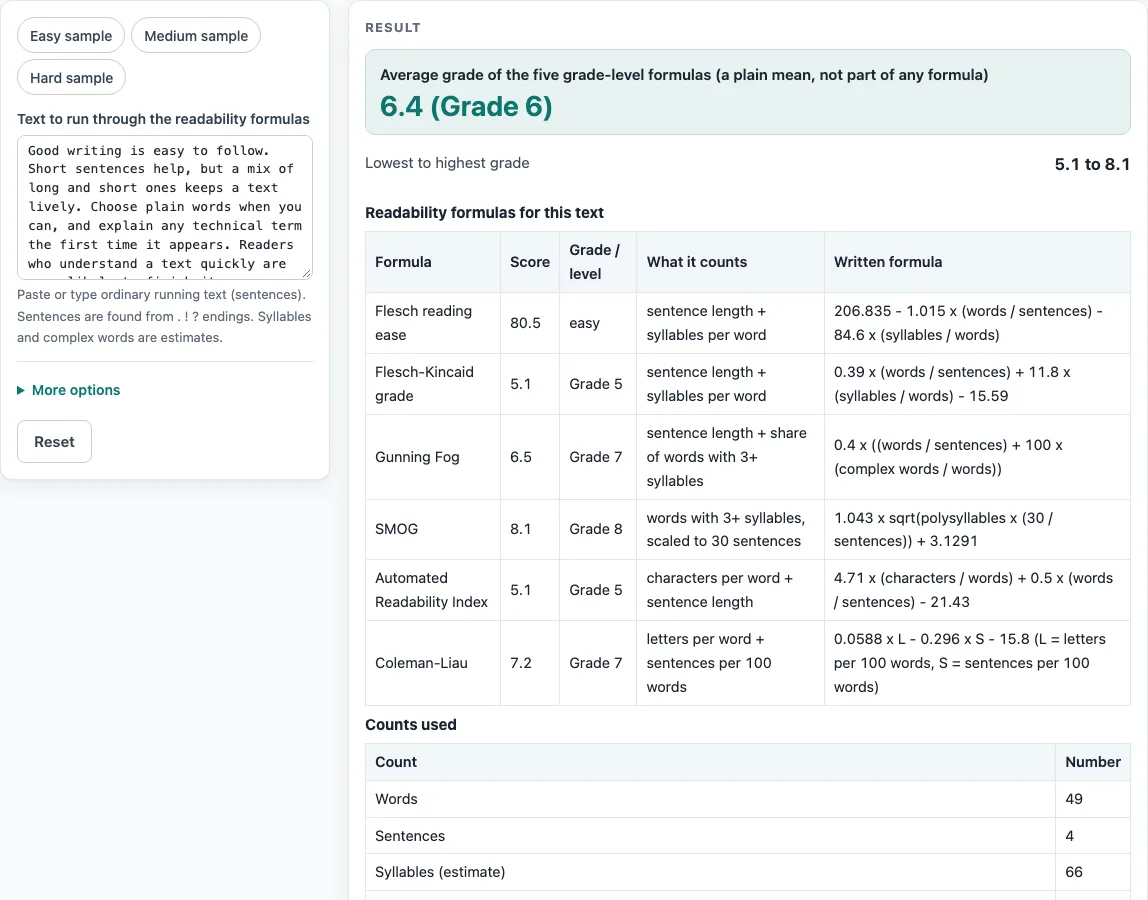
How to use the readability formula calculator
- Paste your text into the box labelled “Text to run through the readability formulas”.
- If each line of your text is a separate sentence, tick “Treat each line as a sentence”.
- To see example output first, click the “Easy”, “Medium” or “Hard” sample preset.
- Read “Average grade of the five grade-level formulas (a plain mean, not part of any formula)”. This is a simple average of the five grade results, not a figure from any formula.
- Check “Lowest to highest grade” to see the range across the formulas.
- Work through the results table, which has one row per formula. Each row shows Score, Grade / level, What it counts and the Written formula.
- Check the table of counts (words, sentences, syllables, letters, complex words, polysyllables). If a count looks wrong, edit your text and run it again.
Scores show one decimal place. Flesch reading ease shows a band name instead of a grade. Text longer than 200,000 characters triggers a warning, and the page also warns about short text, lists and headings, which are covered in the FAQ below. Use Copy result to copy the numbers as text, Copy link to copy a web address that reopens the tool with your settings, and Print / save as PDF to keep a record. Reset returns the tool to its starting sample. A very long pasted text is left out of the copied link.
What are the readability formulas?
The formulas on this page are Flesch reading ease (Flesch 1948), Flesch-Kincaid grade (Kincaid et al. 1975), Gunning Fog (Gunning 1952), SMOG (McLaughlin 1969), Automated Readability Index (Smith & Senter 1967, constants as in Kincaid 1975) and Coleman-Liau (Coleman & Liau 1975). Each one estimates difficulty from surface counts. Four use syllables or words with 3+ syllables, and two use letters. Dale-Chall, Fry and Spache are not computed here, because they need word lists or graphs.
What is a readability index?
A readability index is a number from a formula such as ARI or Coleman-Liau that estimates the grade needed to read a text. The grade formulas return US school grades. Reading ease returns a score where higher means easier.
What is text complexity?
Text complexity is broader than any one formula. The Common Core State Standards (Appendix A) describe three parts: qualitative dimensions, such as levels of meaning, structure, language conventionality and clarity, and knowledge demands; quantitative dimensions, such as word length or frequency, sentence length and text cohesion, measured by software; and reader and task considerations. This is a paraphrase, not a quote. Readability formulas cover only part of the quantitative dimension.
Why do formulas give different grades?
They count different things and use different constants, so they disagree on the same text. In the Medium sample (49 words, 4 sentences, 66 syllables), Flesch-Kincaid gave Grade 5 (5.1), while SMOG gave Grade 8 (8.1). The average was Grade 6 (6.4), and the range was 5.1 to 8.1. The page shows every formula and the range so you can see that spread instead of relying on one number.
Are readability tests accurate?
They are rough guides to surface difficulty only. Readability formulas measure sentence length and word or syllable length. They do not measure meaning, correctness, organisation or what a reader already knows, so they cannot judge whether a text suits a reader. Syllable counts come from a dictionary where the word is listed and a rule-based estimate otherwise, so every score is an estimate.
Sources (checked 2026-10-15): Flesch–Kincaid readability tests (Wikipedia); Gunning fog index (Wikipedia); SMOG (Wikipedia); Automated readability index (Wikipedia); Coleman–Liau index (Wikipedia).
Worked examples
| Input | Result |
|---|---|
| The cat sat on the mat. It was a warm day. The dog ran to... | average grade 0.3 (range -2.5 to 3.1) |
| Good writing is easy to follow. Short sentences help, but... | average grade 6.4 (range 5.1 to 8.1) |
| Organizations frequently underestimate the administrative... | average grade 23.4 (range 16.7 to 31.8) |
Calculated by the tool above; open it with the same values to see each step.
Frequently asked questions
Which readability formula is best?
None is best. The formulas weigh different counts and often differ by a few grades. Compare them, and use the average and range shown on the page.
What does SMOG measure?
SMOG counts words with 3+ syllables (polysyllables) and scales that count to 30 sentences. The tool scales shorter texts and warns when there are fewer than 30 sentences.
Can I get Fry, Dale-Chall or Spache scores here?
No. These formulas need word lists or graphs, so this page does not compute them. It runs the six formulas listed above.
Is the text I paste saved or uploaded?
No. Everything runs in your browser, and the site never uploads or stores the text you paste. Text over 200,000 characters triggers a warning.
Why does the page warn me about my text?
Formulas assume running prose, so lists and headings can distort the sentence count. Very short text, under 3 sentences or 30 words, also gets a warning. Results for that kind of text are less reliable.
Why is Flesch reading ease shown as a band?
It is not a grade. A higher score means easier text, so the table shows its reading-ease band instead of a grade.
Can I share or print my result?
Copy result copies the numbers as text, Copy link copies a web address that reopens the tool with your settings, and Print / save as PDF opens your browser’s print dialog. A very long pasted text is left out of the link.
Related tools
- Gunning Fog index calculator: use it when you only need the Gunning Fog result.
- SMOG index calculator: use it when you only need the SMOG result.
- Automated Readability Index calculator: use it when you only need the ARI result.
- Coleman-Liau index calculator: use it when you only need the Coleman-Liau result.
- Flesch-Kincaid calculator: use it when you only need the Flesch-Kincaid grade.
- Reading level checker: use it when you want to check a reading level instead of comparing formulas.