Reading Level Checker
Paste your text to find its reading grade level and typical age.
Recent
Your last 10 settings, saved only in this browser. Nothing is uploaded.
How to use the reading level checker
- Paste your text into the Text to check box. A full paragraph or more gives a steadier result than a single line.
- Optional: turn on Treat each line as a sentence if each line is its own sentence, such as a list of short questions or a poem.
- Optional: open Compare with a target grade and choose None, Kindergarten, Grade 1 through Grade 12, or College.
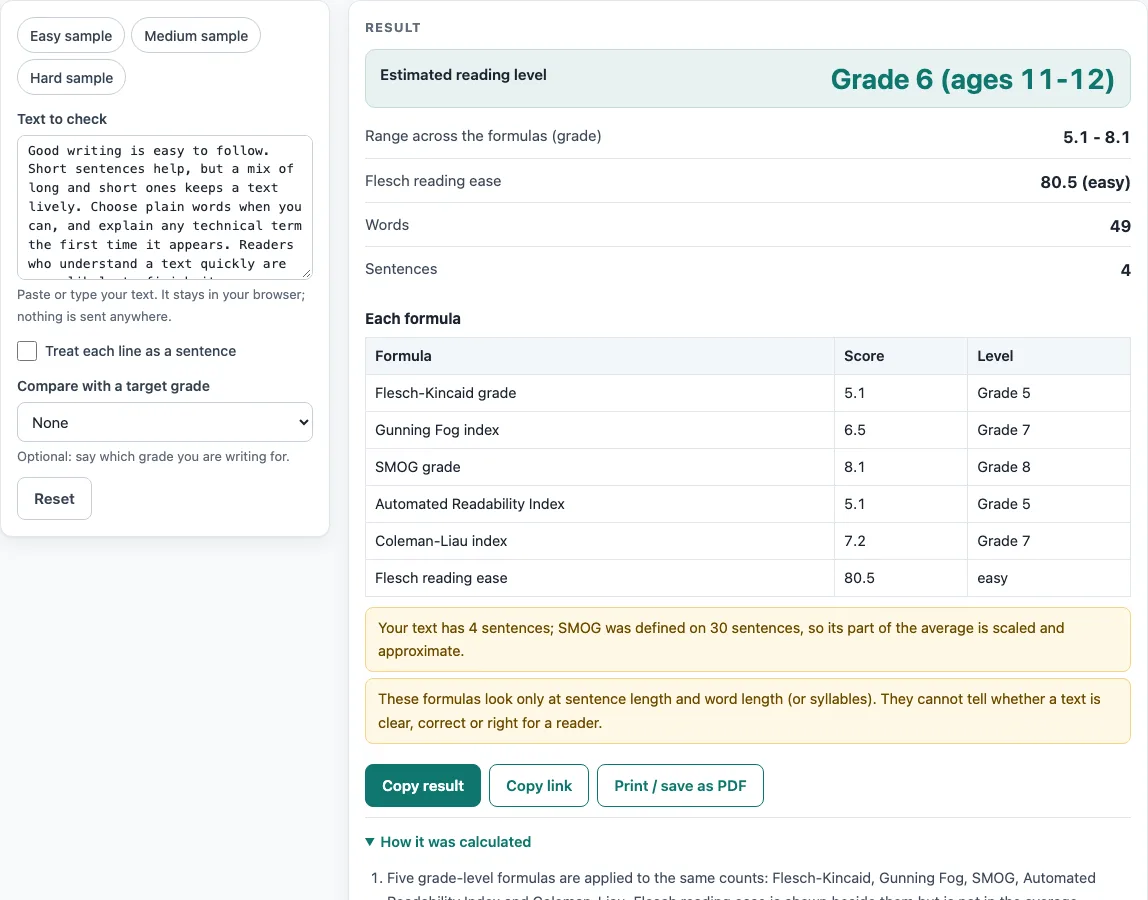
- Read Estimated reading level. It shows a grade and typical ages, for example “Grade 8 (ages 13-14)”.
- If you chose a target, check Against the target to see whether the text is about at, above or below it.
- Look at Range across the formulas (grade) to see how far apart the five formulas are.
- Check Flesch reading ease for a score and band. Then confirm Words and Sentences match what you expect.
- Open the Each formula table to see the score and level from each formula.
- Read any warnings above or below the results before you act on them.
To try the tool first, click the Easy, Medium or Hard sample chips to load a sample text. A blank line in your text marks a paragraph break. A single line break counts as a space unless Treat each line as a sentence is on.
Why do formulas disagree?
Each readability formula gives a different grade for the same text because each one weighs different features. The five formulas used here are Flesch-Kincaid (Kincaid et al., 1975), Gunning Fog (Gunning, 1952), SMOG (McLaughlin, 1969), Automated Readability Index (Smith & Senter, 1967) and Coleman-Liau (Coleman & Liau, 1975). Flesch-Kincaid uses sentence length and syllables per word. Gunning Fog counts sentence length and words of three or more syllables. SMOG counts words of three or more syllables. The Automated Readability Index counts characters per word and words per sentence. Coleman-Liau counts letters rather than syllables.
Take the sentence “The children walked to school together on Monday.” It scores 5.2 on Flesch-Kincaid, 8.2 on Gunning Fog, 8.8 on SMOG, 6.7 on the Automated Readability Index and 10.6 on Coleman-Liau. Those five numbers form the range of 5.2 to 10.6. The tool averages them to 7.92 and rounds that to Grade 8. The average is a convenience figure the tool calculates. It is not part of any of the formulas. That is why the tool shows the range and each score, not just the average.
Is a free reading level checker accurate?
It is accurate as a formula estimate of sentence and word length, but it cannot measure how a particular reader will understand a text. Syllable counts come from the CMU Pronouncing Dictionary where a word is listed, and from a rule-based estimate otherwise. That rule agrees with the dictionary on 90% of 117,000 words, so syllable counts are close but not exact. Scores are therefore estimates.
Short text gives rough results. Under 20 words or 3 sentences, the tool shows a “very short text, treat as rough” warning. SMOG was defined on 30 sentences, so when a text has fewer than 30, the tool shows a SMOG warning because that formula is scaled. Formulas cannot judge meaning, correctness, topic difficulty or the background of the reader. Two texts with the same sentence and word lengths can differ a lot in how hard they are to follow.
Sources (checked 2026-10-15): Flesch–Kincaid readability tests (Wikipedia); Gunning fog index (Wikipedia); SMOG (Wikipedia); Automated readability index (Wikipedia); Coleman–Liau index (Wikipedia).
Worked examples
| Input | Result |
|---|---|
| Good writing is easy to follow. Short sentences help, but... | Grade 6 (ages 11-12) |
| The cat sat on the mat. It was a warm day. The dog ran to... | Kindergarten (ages 5-6) |
| Organizations frequently underestimate the administrative... | College (ages 18+) |
Calculated by the tool above; open it with the same values to see each step.
Frequently asked questions
What reading level is my writing?
The big number under Estimated reading level is the US grade your text is estimated to be written at, with typical ages beside it, such as “Grade 6 (ages 11-12)”. Check Range across the formulas (grade) as well, because a wide range means the formulas disagree more.
What grade level should I write at?
That depends on who will read the text. Choose a grade in Compare with a target grade, and the tool tells you whether your text is about at, above or below that grade. It counts a result within one grade of the target as “about at.”
What does the Flesch reading ease score mean?
It is a score from 0 to 100, and a higher score means the text is easier to read. A score of 60 to 70 is plain English, 80 to 90 is easy, and 30 to 50 is difficult. Very simple text can score above 100, as the test sentence “The cat sat on the mat. It was a warm day.” did with 116.7.
Does the tool upload my text?
No. The tool runs in your browser, and the text you paste is never uploaded or stored by the site. You do not need to sign up or create an account.
Can I check a very short text?
You can, but treat the result as rough. Under 20 words or 3 sentences, the tool shows a “very short text, treat as rough” warning. Add more sentences if you want a more useful estimate.
Related tools
- What is reading level: read this first if you want the basic idea before looking at any scores.
- Kindergarten reading level checker: use it when you are checking text for the youngest readers.
- Flesch-Kincaid calculator: use it when you want to focus on the Flesch-Kincaid grade on its own.
- Readability formulas compared: read it to see how the five formulas differ in what they count.
- Flesch reading ease scale: use it to understand the bands behind a Flesch reading ease score.
- Readability checker: go here to check a text for readability in general.