Run On Sentence Checker
Paste your text to flag sentences that may be run-ons, see why, and get ways to fix them.
Recent
Your last 10 settings, saved only in this browser. Nothing is uploaded.
How to use the run-on sentence checker
- Paste your text into the Text box. It accepts up to 200,000 characters.
- Optionally, pick a preset. Run-on sample shows a worked example, Correct sentences gives you clean text to compare against, and Mark above 10 words flags shorter sentences.
- Check the two settings. Mark sentences longer than (words) defaults to 30, and Mark sentences with at least this many and/but/or/nor defaults to 3. Lower them to flag more sentences, or raise them to flag fewer.
- Turn on Treat each line as a sentence if every line of your text is one sentence. It is off by default.
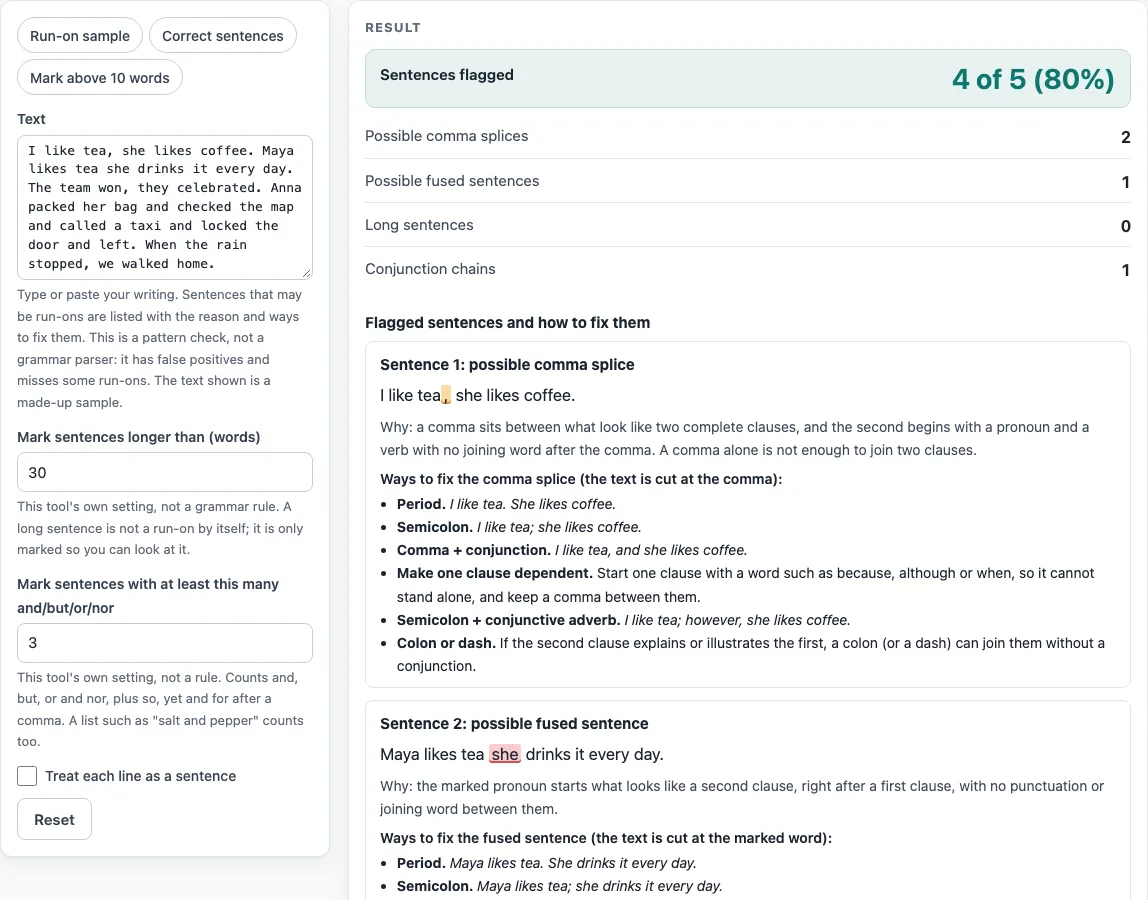
- Read the results. Sentences flagged shows a figure such as “4 of 5 (80%)”. Below it, Possible comma splices, Possible fused sentences, Long sentences and Conjunction chains show a count for each type.
- Scroll to Flagged sentences and how to fix them. Each card shows the sentence with its suspect spot marked, a Why line, and fix options with a preview. Choose the fix that matches what you mean.
- Check Your text, suspect spots marked to see the whole text. Commas, clause starts and conjunctions are marked, and long sentences have a dotted underline.
The presets and settings control what gets marked, so you can start with a preset to see how the tool behaves and then adjust the numbers for your own writing. The cards display up to 200 flagged sentences, but the counts above them cover every flag in the text.
What is a run-on sentence?
A run-on sentence joins two or more independent clauses, which are complete statements with their own subject and verb, without a coordinating conjunction or correct punctuation. A run-on can be very short, as in “I drive, she walks.”
Some writers use “run-on” only for clauses with no punctuation between them. Others include comma splices, where a comma alone joins the clauses. A fused sentence is the first kind, such as “It is nearly half past five we cannot reach town before dark.” Both kinds can be fixed with a period, a semicolon, or a connecting word.
A run-on sentence finder can only check patterns. It cannot know what you meant, so it reports a sentence as a possible run-on and leaves the decision to you. Length alone does not make a sentence a run-on.
What is a comma splice?
A comma splice joins two independent clauses with only a comma, as in “I like this class, it is very interesting.” A comma cannot hold two complete statements together on its own, so the sentence needs a stronger break.
It is usually considered an error in English writing. Garner’s Modern English Usage notes that most usage authorities accept it when the clauses are short and closely related, the meaning cannot be misread, and the context is informal. Strunk and White allow a comma between very short clauses that are alike in form, such as “The gate swung apart, the bridge fell, the portcullis was drawn up.”
Splices often happen when a writer uses a conjunctive adverb such as however or moreover where a semicolon or a period is needed, so “It was hard to concentrate, however, I finished” should read “It was hard to concentrate; however, I finished.”
The usual fixes are a period, a semicolon, a coordinating conjunction after the comma (for, and, nor, but, or, yet or so), or making one clause dependent. A semicolon before a conjunctive adverb such as however also works. The checker flags “I like tea, she likes coffee.” as a possible comma splice and offers each of these fixes as a preview.
Sources (read 2026-10-18): Purdue OWL, Independent and Dependent Clauses; Wikipedia, Run-on sentence and Comma splice.
Worked examples
| Input | Result |
|---|---|
| I like tea, she likes coffee. Maya likes tea she drinks it every day. The team won, the... | 4 of 5 sentences flagged |
| We went to the park, and we played football until dark. The team won; they celebrated. ... | 0 of 4 sentences flagged |
| I drive, she walks. My professor is intelligent I have learned a lot from her. | 2 of 2 sentences flagged |
Calculated by the tool above; open it with the same values to see each step.
Frequently asked questions
Can the checker find every run-on?
No. The checker finds patterns, so it can miss some run-ons. It can miss a second clause that starts with a noun, as in “The gate swung apart, the bridge fell.” It can also miss some fused sentences that follow a noun phrase with a determiner. It can also flag sentences that are not run-ons, such as the idiom “I know, I know.” Read every flag and check the sentences the tool does not mark.
Does it check sentence fragments?
No. The tool does not check sentence fragments or any other grammar. It only looks for comma splices, fused sentences, long sentences and conjunction chains. A sentence without a verb will not be flagged for that reason.
Is my text uploaded?
No. The tool runs in your browser, and nothing is sent. Your text stays on your device while you use the checker.
Is a long sentence a run-on?
Not necessarily. The checker marks a sentence as long when it has more words than the setting, which defaults to 30, but length alone does not make a run-on. A long sentence with one independent clause and correct punctuation is fine. Check whether the sentence joins two complete statements without proper punctuation. Some dictionaries also use the word “run-on” for a very long sentence that lacks order, which is why this tool marks long sentences too.
Is this a comma splice checker?
Yes. It flags possible comma splices as well as fused sentences, and the Possible comma splices row counts them. It uses the same pattern check, so it can flag a splice that is a deliberate style choice and miss one it does not recognise.
Is “I came, I saw, I conquered” a run-on?
No, and the checker does not flag it. The three clauses are short and parallel, so the tool treats them as a comma series. Some style guides accept this kind of series and some do not, so decide based on the style your work follows.
How do I fix a run-on?
Start by deciding how the two ideas relate. You can split them with a period, join them with a semicolon, or add a comma and a coordinating conjunction such as and, but or so. If the second clause explains the first, a colon or dash can work. You can also make one clause dependent by adding a word such as because or although.
Related tools
- Passive voice checker: use it when you want to find sentences where the subject receives the action.
- Sentence counter: use it when you need a total count of sentences in a piece of writing.
- Average sentence length calculator: use it when you want to see how long your sentences are on average.
- Active voice checker: use it when you want to find sentences that need a clearer subject and verb.
- Plain language examples and checker: use it when you want examples of shorter, clearer wording.