SMOG Index Calculator
Paste your text to get its SMOG grade from its long words.
Recent
Your last 10 settings, saved only in this browser. Nothing is uploaded.
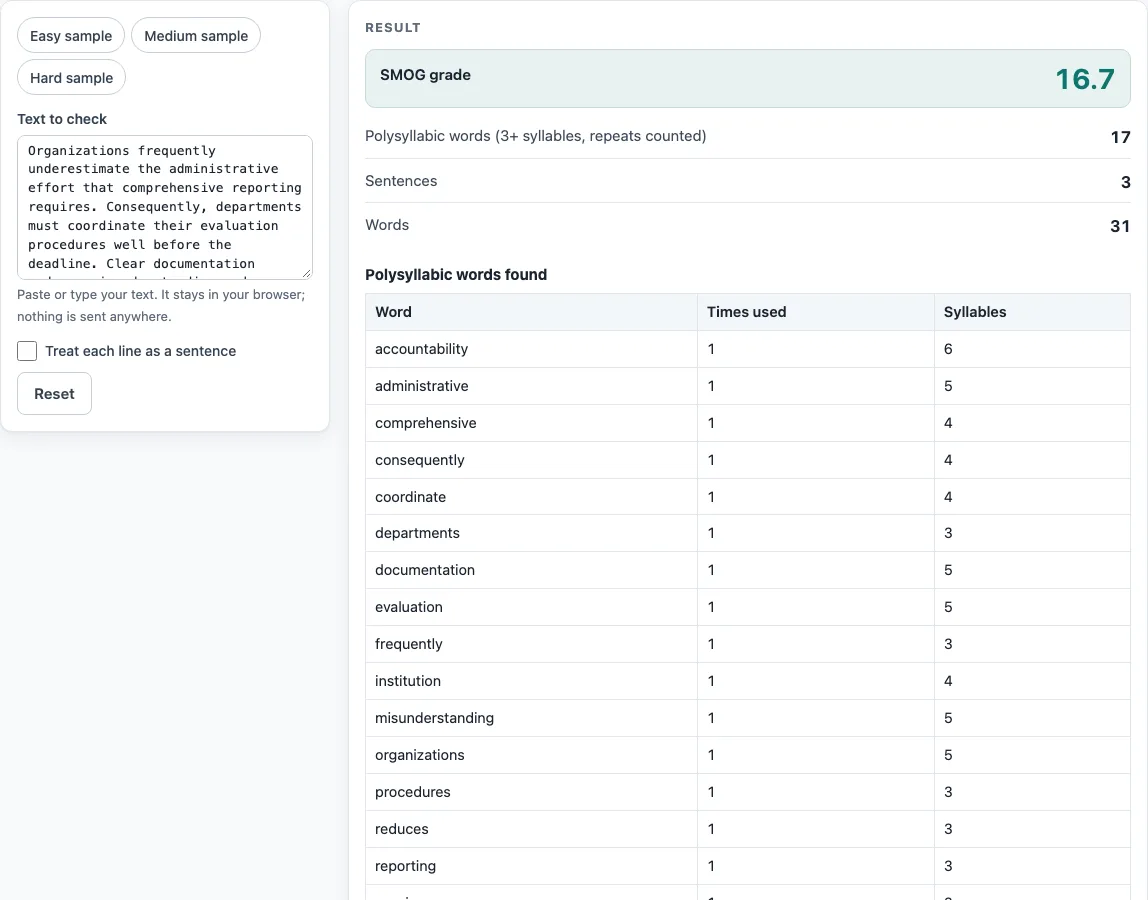
How to use the SMOG index calculator
- Click into the Text to check box and paste your text. To try the tool first, click the Easy, Medium or Hard sample chip.
- Leave Treat each line as a sentence off for normal prose. A blank line starts a new paragraph. Turn the option on only if each line is its own sentence, such as a list of short items.
- Read the SMOG grade number at the top of the results.
- Check Polysyllabic words (3+ syllables, repeats counted), Sentences and Words to see what the score is based on.
- Open How it was calculated to see the formula with your own counts filled in.
- Read any warnings. A text under 20 words or 3 sentences gets a “very short text, treat as rough” warning. A text with fewer than 30 sentences gets a scaling warning, and one with fewer than 10 sentences gets “too short for a reliable SMOG”.
- Scroll to Polysyllabic words found to see each distinct long word, how many times it is used, and its syllable count. The table shows up to 100 rows.
The only setting is the Treat each line as a sentence option, so there is nothing to configure before you paste.
What does SMOG stand for?
SMOG stands for “Simple Measure of Gobbledygook.” It is a readability formula that G. Harry McLaughlin published in 1969 to estimate the school grade a text is written at. It uses only one measure of word length: how many words have three or more syllables.
What is the SMOG formula?
The formula is 1.0430 × √(polysyllables × 30 ÷ sentences) + 3.1291. Multiply the polysyllable count by 30, divide by the sentence count, take the square root, multiply by 1.0430, then add 3.1291. The tool’s default Hard sample has 17 polysyllables in 3 sentences, which gives a SMOG grade of 16.7.
How many sentences do I need?
The paper that defined SMOG uses 30 sentences. The classic hand method takes three samples of ten sentences each. This tool takes the whole text and scales the count to 30 sentences, so you can paste any length. Texts with fewer than 30 sentences get a scaling warning, and texts with fewer than 10 get “too short for a reliable SMOG”. The 10-sentence limit is this tool’s setting, not part of the original formula.
What counts as a polysyllabic word?
A polysyllabic word has three or more syllables. The tool counts every occurrence, so a word used five times adds five to the count. Hyphenated words and proper nouns count by their syllables, with no exclusions. Numerals count as one syllable. Syllables come from the CMU Pronouncing Dictionary (first pronunciation) where a word is listed, and from a rule-based estimate otherwise.
Who made SMOG?
G. Harry McLaughlin made SMOG. He described it in “SMOG grading - a new readability formula”, Journal of Reading 12(8), May 1969, pages 639-646.
Is SMOG a grade?
Yes. SMOG gives a US school-grade estimate, so a score of 8.8 estimates that the text is written at about the eighth-grade level. The score is based on word length and sentence count only, so it cannot show whether the text is clear or accurate.
SMOG vs Flesch-Kincaid?
SMOG looks only at long words per sentence, counting words of three or more syllables. Flesch-Kincaid also uses the average number of syllables per word, so it measures word length in a different way. Both return a grade-level estimate, but they can give different results for the same text.
Sources (checked 2026-10-15): SMOG (Wikipedia).
Worked examples
| Input | Result |
|---|---|
| Organizations frequently underestimate the administrative... | SMOG grade 16.7 (17 polysyllables in 3 sentences) |
| The cat sat on the mat. It was a warm day. The dog ran to... | SMOG grade 3.1 (0 polysyllables in 4 sentences) |
| Good writing is easy to follow. Short sentences help, but... | SMOG grade 8.1 (3 polysyllables in 4 sentences) |
Calculated by the tool above; open it with the same values to see each step.
Frequently asked questions
Does this tool store the text I paste?
No. Everything runs in your browser, and the text you paste is never uploaded or stored by the site. There is no sign-up and no account.
Why might my polysyllable count differ from a hand count?
Syllable counts are estimates. The tool uses a dictionary count where a word is listed and a rule otherwise. The rule agrees with the dictionary on 90% of 117k words, so the polysyllable list can differ by a word or two from a hand count.
What is the lowest score the tool can return?
The result is never below 3.1291. That is the score for a text with zero polysyllables.
Can a readability score tell me whether my text is clear?
No. Readability formulas measure only sentence length and word or syllable length. They cannot judge meaning, correctness, or whether a text suits a particular reader.
Where do 1.0430 and 3.1291 come from?
They are the constants of McLaughlin’s 1969 SMOG equation. The tool uses them as published.
Can I share or print my result?
Copy result copies the numbers as text, Copy link copies a web address that reopens the tool with your settings, and Print / save as PDF opens your browser’s print dialog. A very long pasted text is left out of the link.
Related tools
- Gunning Fog index calculator: use it when you want a second grade-level estimate based on sentence length and complex words.
- Automated Readability Index calculator: use it when you want a score based on characters per word rather than syllables.
- Coleman-Liau index calculator: use it when you want a score that counts letters rather than syllables.
- Flesch-Kincaid calculator: use it when you want a score that also uses average syllables per word.
- Readability formulas compared: read it to see how the main formulas differ before choosing one.
- Reading level checker: use it when you want to check a text against a reading level.
- Readability checker: return to the main page to run a text through the tool.