Syllable Checker
Paste your lines to check the syllables in each one against a target pattern.
Recent
Your last 10 settings, saved only in this browser. Nothing is uploaded.
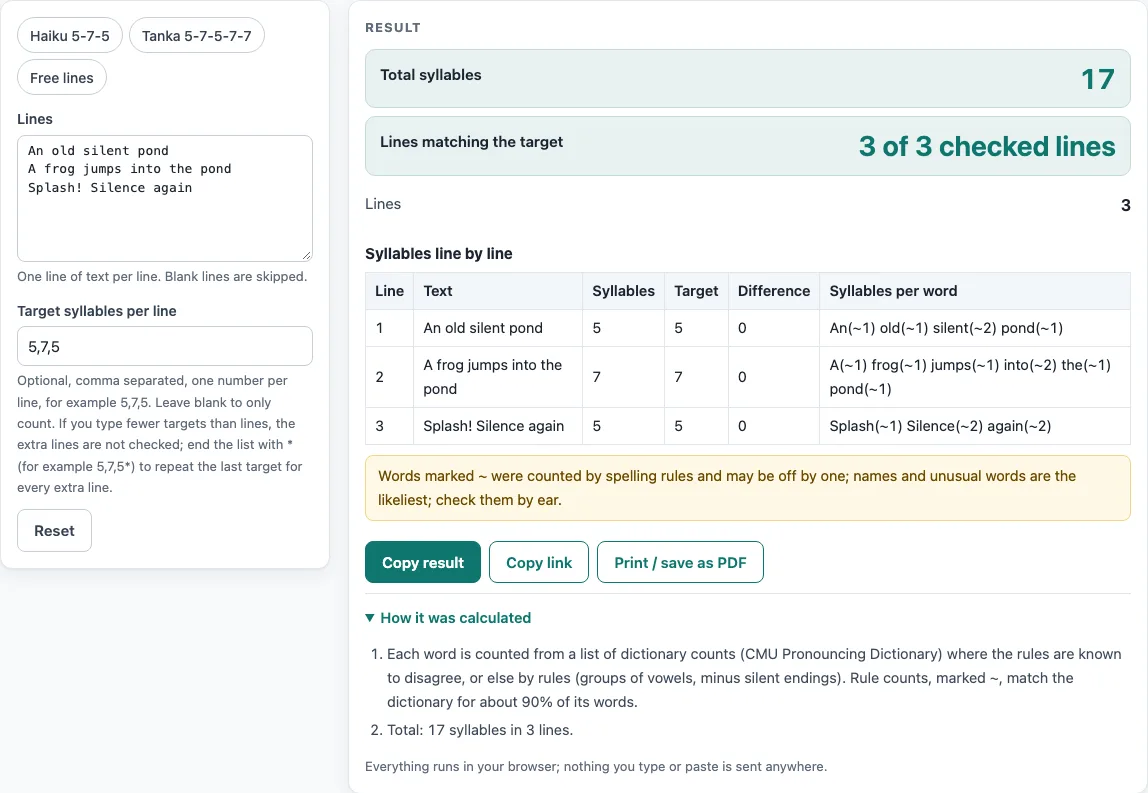
How to use the Syllable checker
- Type or paste one line of your poem on each line of the Lines box. Blank lines are skipped and do not take a line number. You can enter up to 500 lines.
- Optional: in Target syllables per line, type your pattern, for example 5,7,5. Separate the numbers with commas or spaces.
- To use a common pattern, click a preset: Haiku 5-7-5, Tanka 5-7-5-7-7, or Free lines.
- If you have fewer targets than lines, end the list with
*(for example5,7*) to repeat the last target for every extra line. - Read the Total syllables figure.
- If you typed targets, read Lines matching the target, which shows text such as “3 of 3 checked lines”.
- Check the table Syllables line by line. Its columns are Line, Text, Syllables, Target, Difference, and Syllables per word.
- Look for a
~in the Syllables per word column. Those words are rule-based estimates, so check them by ear.
The page loads a sample haiku with the target 5,7,5 so you can see a working example before you type your own poem. Replace the sample text with your lines and the results update to match what you enter. Use Copy result, Copy link or Print / save as PDF to keep the result, and Reset to return to the sample.
How do I check syllables in each line of a poem?
Put one line of the poem on each line of the Lines box, and the tool counts the syllables in each line separately. A syllable is a beat of spoken sound. Counting is by the vowel sounds you hear, not by the letters you see. “Water” has 2 syllables, “banana” has 3, and “beautiful” has 3.
The tool uses counts from the CMU Pronouncing Dictionary (BSD-2-Clause) for the words where simple spelling rules are known to get the count wrong. Every other word is counted by the spelling rules, and the table marks those counts with ~. The rule counter agrees with the dictionary about 90% of the time. Hyphenated words are summed piece by piece, and numbers count as 1.
How do I check 5-7-5?
5-7-5 is a pattern of 5 syllables on the first line, 7 on the second, and 5 on the third. It is an English-language convention for haiku, and other poetry forms also use syllable patterns. To check it, type 5,7,5 into Target syllables per line. The tool compares line 1 with 5, line 2 with 7, and line 3 with 5.
The Difference column shows each line’s result as +2, -1, or 0. A 0 means the line matches its target. For example, “Snow falls on the roof / Soft and quiet all night / Morning light returns” gives 5, 6, and 5 syllables. Line 2 shows a Difference of -1, and the summary reads “2 of 3 checked lines”.
A syllable count cannot judge meaning, rhythm or whether a poem works. It only tells you how many beats each line has, by dictionary or by estimate.
Sources (checked 2026-10-15): CMU Pronouncing Dictionary.
Worked examples
| Input | Result |
|---|---|
| An old silent pond ... (5,7,5) | 17 syllables, 3 of 3 lines match |
| The evening is still ... (5,7,5,7,7) | 31 syllables, 5 of 5 lines match |
| Roses are red ... | 17 syllables in 4 lines |
| Roses are red ... (6*) | 17 syllables, 0 of 4 lines match |
Calculated by the tool above; open it with the same values to see each step.
Frequently asked questions
What if my poem has more lines than targets?
Extra lines are not checked. Their Target shows as “-”, and a warning tells you so. To check every line, end the list with *, for example 5,7*, which repeats the last target for each extra line.
Which words are uncertain?
Words with a ~ in the last column, Syllables per word, were counted by spelling rules and may be off by one. Check those words by ear by saying them aloud.
Can it count syllables in a single word?
Yes. Put the word on its own line in the Lines box. For more on single words, use the Syllable counter.
Why does a line differ by one from my count?
The rule-based counter agrees with the dictionary about 90% of the time, so a word counted by rule can be one syllable off. Find the words marked ~, say them aloud, and compare the count with your own reading.
How is the Difference worked out?
Difference is the line’s syllables minus its target. A +2 means two more syllables than the target, a -1 means one fewer, and a 0 means a match. It shows “-” when the line has no target.
Does the tool store the text I type?
No. The tool runs in your browser, nothing you enter is sent, and it is free with no sign-up or account.
Related tools
- Syllable counter: use it to count syllables in words and short passages without line-by-line targets.
- Haiku syllable counter: use it when you are writing or checking a haiku.
- Sentence counter: use it to count sentences in a passage.
- Flesch reading ease calculator: use it to work out a Flesch reading ease score from a passage.
- Flesch-Kincaid calculator: use it to work out a Flesch-Kincaid grade level from a passage.
- Readability checker: use it to look at a passage’s readability measures in one place.