Transition Words List
Browse transition words and phrases by purpose, copy any of them, or paste your text to see which ones it uses.
Recent
Your last 10 settings, saved only in this browser. Nothing is uploaded.
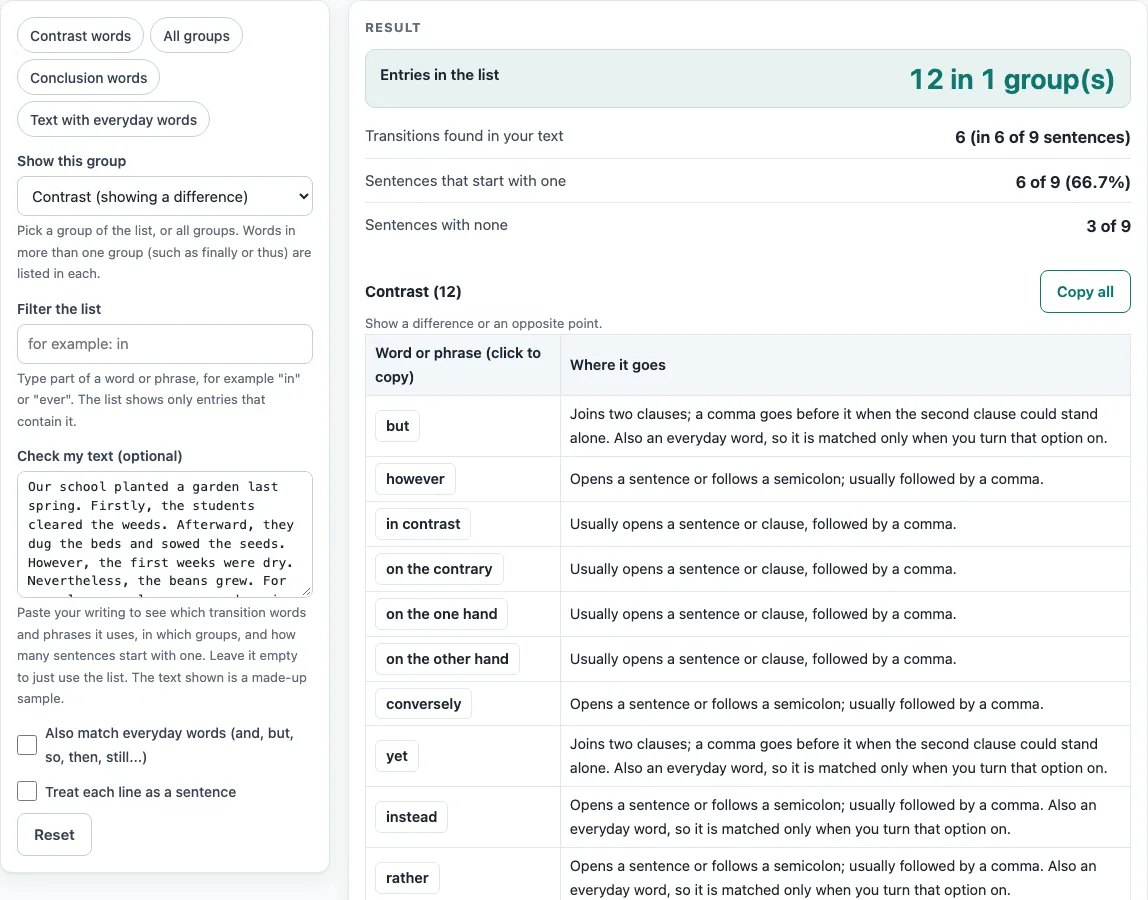
How to use the transition words list tool
- Open Show this group and pick a group, such as Contrast (the default) or Time. Choose All groups to see every entry.
- Type part of a word into Filter the list. Only entries that contain that text stay visible. The match ignores capital letters.
- Click any word or phrase in the Word or phrase (click to copy) column to copy it. To copy a whole group, click Copy all for that group.
- To check your own writing, paste up to 200,000 characters into Check my text (optional). Leave it empty if you only want the list.
- Tick Also match everyday words (and, but, so, then, still…) if you want those counted. It is off by default, because these words are often not transitions.
- Tick Treat each line as a sentence if your text has one sentence per line.
- Read the results rows: Entries in the list, Transitions found in your text, Sentences that start with one and Sentences with none. Then scroll to Your text, transitions marked to see each match in context.
The four presets, Contrast words, All groups, Conclusion words and Text with everyday words, fill in the controls for you. Use them as a quick starting point, then adjust the filter or checkboxes as needed.
What are transition words?
Transition words are linking words and phrases that show how one idea relates to the next. However signals contrast, for example signals an illustration, and in summary signals a conclusion. They add cohesion, which is the sense that sentences and paragraphs belong together. Writing guides often group them by the logical relationship they signal: similarity, contrast, sequence, time, example, emphasis, place, cause and effect, additional support, and conclusion. The groups in this tool follow that idea, with concession added as a separate group.
Where do transition words go?
Position depends on the type of word. Conjunctive adverbs such as however, therefore and moreover open a sentence or follow a semicolon, as in “I told him; however, he did not remember.” Coordinating conjunctions such as and, but and so join two clauses. Subordinating words such as because start a clause that cannot stand alone. Phrases such as in addition or on the other hand usually open a sentence or clause. The Where it goes column in the tool labels each entry with its type.
Between paragraphs, a transition can sit at the end of the first paragraph, the start of the second, or both. Within a paragraph, a single word or short phrase is usually enough to signal what comes next. Make the transition point back to specific material from the previous paragraph. A vague addition such as “also” adds an idea without connecting it to anything.
Which transition words belong to which job?
The list has 11 groups. Addition words such as moreover and in addition add another point. Similarity words such as likewise show that two things are alike, while Contrast words such as however and on the other hand show a difference. Concession words such as nevertheless and nonetheless grant a point and carry on. Cause and effect words such as therefore and consequently give a reason or a result. Example words such as for instance introduce an illustration, Sequence words such as firstly and finally put points in order, and Time words such as meanwhile say when things happen. Emphasis words such as indeed stress a point, Conclusion and summary words such as in conclusion wrap up, and Place words such as nearby say where. A few words work in more than one group, such as finally and thus, so the tool lists them in each.
Sources (read 2026-10-18): UNC Writing Center, Transitions; Wikipedia, Conjunctive adverb and Transition (linguistics); Purdue OWL, Transitions and Transitional Devices and Independent and Dependent Clauses.
Worked examples
| Input | Result |
|---|---|
| Contrast (showing a difference) | 6 transitions in 9 sentences |
| All groups, filter "in " | 6 transitions in 9 sentences |
| Cause and effect (reasons, results) | 2 transitions in 3 sentences |
Calculated by the tool above; open it with the same values to see each step.
Frequently asked questions
Do I put a comma after a transition word?
Usually yes when the transition opens a sentence, as in “However, the plan failed.” When a conjunctive adverb joins two independent clauses, put a semicolon before it and a comma after it: “The plan failed; however, we learned from it.” A coordinating conjunction such as but takes a comma before it when the second clause could stand alone.
How many transitions should I use?
The tool does not set a target number and has no “too many” limit. It only counts. In the default sample, 6 of 9 sentences (66.7%) start with a transition. Whether a link between ideas is needed is a judgement only you can make.
Is “and”, “but” or “so” a transition?
They are coordinating conjunctions, so they link two clauses, but in a given sentence they are often just joining words and not signalling a relationship. The tool treats and, but, so, then, still and similar words as everyday words. They are only matched when Also match everyday words is ticked.
Can the tool tell me if a transition is used correctly?
No. It finds matches from its list and counts them. It shows which sentences start with a transition and which have none, but it cannot judge whether a link fits your meaning or is the right choice for your sentence.
Can I copy the words?
Yes. Click any word or phrase in the Word or phrase (click to copy) column to copy it. To copy every entry in a group, use Copy all for that group.
Is my text uploaded?
No. The checker runs in your browser, and nothing you paste is sent.
Related tools
- Passive voice checker: use it to find passive sentences that may need rewriting for clarity.
- Sentence counter: use it to count the sentences in a draft before you check how many start with a transition.
- Average sentence length calculator: use it to see how long your sentences are on average.
- Active voice checker: use it to check how often your sentences use active voice.
- Plain language examples and checker: use it to compare wordy phrases with simpler alternatives.
- Readability score checker: use it to get a readability score for your whole text.