What Is Reading Level?
Pick a grade, an age or a score to see the matching reading level.
Recent
Your last 10 settings, saved only in this browser. Nothing is uploaded.
Reading level is a grade-level estimate of how hard a text is to read, usually produced by a readability formula. This reading level converter translates between a US grade, an age and a Flesch-Kincaid score, then explains what each result means. It runs in your browser, is free, and needs no sign-up.
The term has two common meanings. Most often it means a US school grade calculated from sentence and word length. Less often it means a level from a book-leveling system used by schools and publishers, which follows that system’s own methods. This page covers the first meaning, which is the one the converter uses.
Use the converter when a score, grade or age in a guide, report or website needs translating into something easier to picture, such as a typical age range or a Flesch reading ease band.
How to use the reading level converter
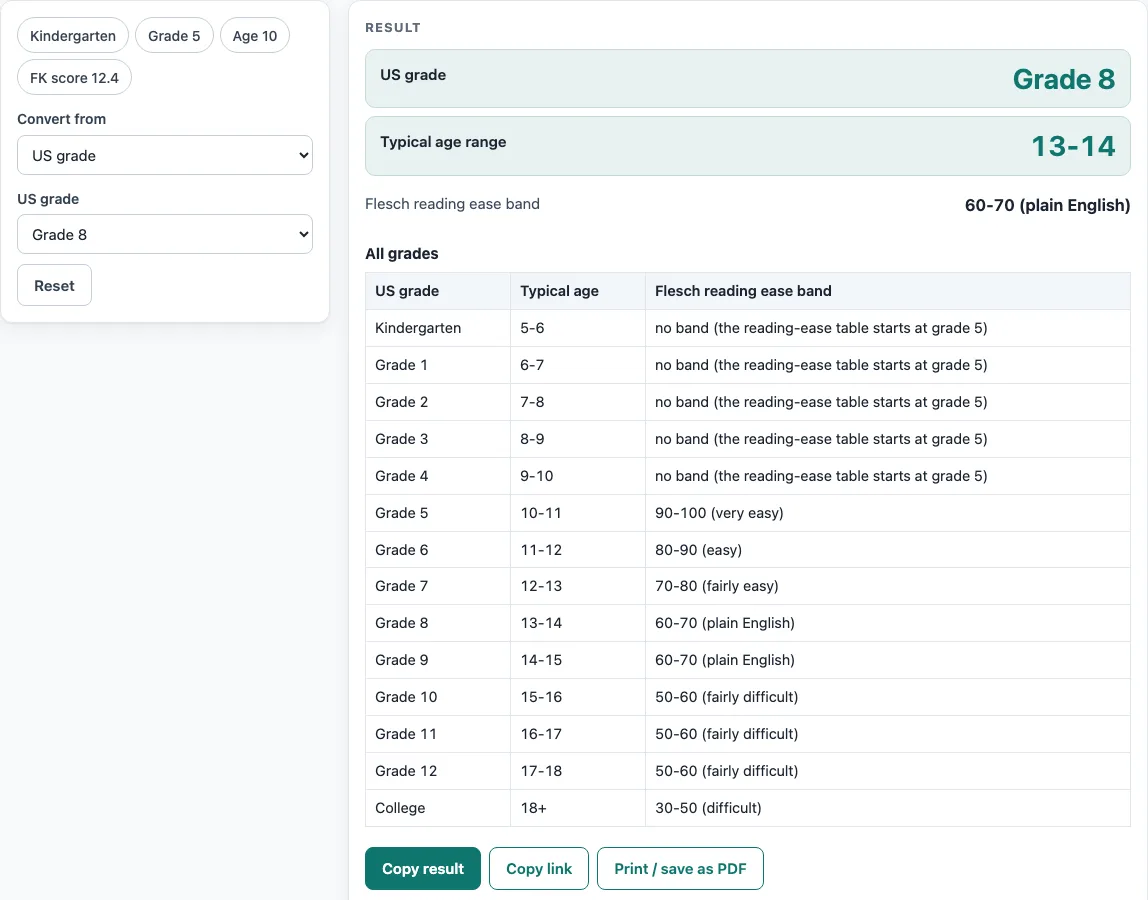
- Choose a starting point under “Convert from”: US grade, Age, or Flesch-Kincaid score.
- Enter a value in the input that appears. For “US grade”, pick Kindergarten, Grade 1 to Grade 12, or College. For “Age (years)”, enter 5 to 18; older ages are treated as 18. For “Flesch-Kincaid grade score”, type a number such as 8.3.
- Read the “US grade” output.
- Check “Typical age range” for the ages usually linked to that grade.
- Check “Flesch reading ease band” for the matching band, such as 60-70 for plain English.
- Read any warning shown. For example, a Flesch-Kincaid score of 12.6 shows College.
- Scroll to the “All grades” table to compare Kindergarten, grades 1 to 12 and College side by side.
The chips above the input fill in example values: Kindergarten, Grade 5, Age 10 and FK score 12.4. Click one to see how the outputs change. The default view is grade 8, which shows ages 13-14 and a band of 60-70. No text is analysed here, so you only enter numbers. Use Copy result to copy the numbers as text, Copy link to copy a web address that reopens the tool with your settings, and Print / save as PDF to keep a record. Reset returns the tool to its starting sample. A very long pasted text is left out of the copied link.
What is reading level?
Reading level is a grade-level estimate of how hard a text is to read, usually from a readability formula. It gives the US school grade a typical student needs to reach in order to follow the text. Flesch-Kincaid output is presented as a U.S. grade level, which is the most common form of this idea.
A grade score says nothing about topic, content maturity or the reader’s skill. A text on a difficult subject can score low, and a strong reader can still find a high-scoring text hard going for other reasons. The score reflects only how sentences and words are built.
How is reading level measured?
Reading level is measured by a formula that counts words, sentences, and syllables or letters, then combines those counts into a single number. The Flesch-Kincaid formula is 0.39 × words per sentence + 11.8 × syllables per word − 15.59. Longer sentences and longer words raise the score, and shorter sentences and shorter words lower it.
Syllable counts come from a dictionary where the word is listed, and from a rule-based estimate otherwise. That means every score is an estimate. Different formulas weigh sentence length, syllables, letters and long words differently, so one text can have different levels under different formulas.
The Flesch reading ease score runs from 0 to 100, with higher numbers meaning easier text. The Flesch reading ease score and the grade-level scores are different formulas and cannot be converted into one another. This converter therefore shows the matching band from the Flesch table, not a conversion. Formulas have no ceiling, so any score above 12 is shown as College.
Readability formulas measure only sentence length and word or syllable length. They cannot judge meaning, correctness, or whether a text suits a particular reader.
Sources (checked 2026-10-15): Flesch–Kincaid readability tests (Wikipedia).
Worked examples
| Input | Result |
|---|---|
| Grade 8 | Grade 8, ages 13-14 |
| age 10 | Grade 4 to Grade 5, ages 9-11 |
| Flesch-Kincaid score 5.4 | Grade 5, ages 10-11 |
| Kindergarten | Kindergarten, ages 5-6 |
Calculated by the tool above; open it with the same values to see each step.
Frequently asked questions
What is the highest reading level?
Formulas have no top, and the usual tables stop at college. The converter shows College for any score above grade 12 and does not invent a higher level.
What age is grade 8?
Grade 8 is typically ages 13 to 14. The default view of the converter shows this, along with a Flesch reading ease band of 60-70.
What reading level is kindergarten?
Kindergarten is grade 0 in this converter and is typically for ages 5 to 6. It has no Flesch reading ease band, because the reading-ease table starts at grade 5.
Why do two tools give different levels?
Each tool may use a different formula, and each formula weighs sentence length, syllables, letters and long words differently. Syllable counts can also differ between tools. Treat every score as an estimate.
What is a Flesch reading ease of 70?
A Flesch reading ease of 70 is labelled fairly easy in the Flesch table, which corresponds to about 7th grade.
Can I check my own text?
Yes, with the reading level checker linked below. This converter does not analyse text. It only translates grades, ages and scores.
Can one age match two grades?
Yes. An age spans two grades: age 10, for example, matches grades 4 and 5, and the converter shows both.
Can I share or print my result?
Copy result copies the numbers as text, Copy link copies a web address that reopens the tool with your settings, and Print / save as PDF opens your browser’s print dialog. A very long pasted text is left out of the link.
Related tools
- Flesch-Kincaid calculator: use it to work out a Flesch-Kincaid grade from your own text.
- Flesch reading ease calculator: use it when you want a reading ease score rather than a grade.
- Flesch reading ease scale: use it to see what each reading ease range means.
- Flesch-Kincaid formula calculator: use it to see how the formula combines its counts.
- Readability formulas compared: use it when you want to understand why different formulas disagree.
- Reading level checker: use it to estimate the reading level of text you paste in.
- Readability checker: use it to start from the main page and check a text.